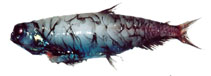
| Family: |
Bathylagidae (Deep-sea smelts) |
| Max. size: |
21.6 cm TL (male/unsexed) |
| Environment: |
bathypelagic; marine; depth range 550 - 6600 m |
| Distribution: |
North Pacific: Iwate Prefecture, Japan to the Bering Sea (Ref. 559) and to British Columbia, Canada and California, USA (Ref. 4925). |
| Diagnosis: |
Dorsal spines (total): 0-0; Dorsal soft rays (total): 7-9; Anal spines: 0-0; Anal soft rays: 23-27; Vertebrae: 50-54. Adipose fin far back on caudal peduncle, relatively large and long; pectorals rather small (Ref. 6885). Color black to dark brown (Ref. 6885). |
| Biology: |
Occurs at a minimum depth of 550 m upon reaching about 5 cm length (Ref. 54657; 82347). Oviparous, with planktonic eggs and larvae (Ref. 35604). Generally mesopelagic and bathypelagic and not ascending to epipelagic depth range (Ref. 96339). |
| IUCN Red List Status: |
Least Concern (LC); Date assessed: 04 February 2009 Ref. (130435)
|
| Threat to humans: |
harmless |
Source and more info: www.fishbase.org. For personal, classroom, and other internal use only. Not for publication.