| Family: |
Pangasiidae (Shark catfishes) |
| Max. size: |
80 cm SL (male/unsexed); max. reported age: 32 years |
| Environment: |
benthopelagic; freshwater; brackish, potamodromous |
| Distribution: |
Asia. |
| Diagnosis: |
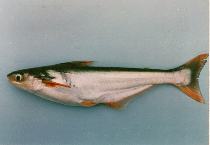
Dorsal spines (total): 2-2; Dorsal soft rays (total): 6-8; Anal spines: 0-0; Anal soft rays: 33-43. Body somewhat elongated with short predorsal length (25.2-29.2% SL); a long caudal peduncle (17.2-21.8% SL); short head length (16.1-20.1% SL); and, short mandibular barbels (length 11.7-42.2% HL). Swim bladder 3-chambered, extending to above anal-fin base (Ref. 46915). Dorsum dark blue to blue-black; 3-4 lowermost principal caudal rays white; vomerine teeth appearing as 2 joined patches in juveniles (Ref. 12693); vomerine teeth united into quadrangular patch, 1.5 times broader than long, not confluent with palatine teeth patch; anal fin base elongate, its length 3.1-3.6 times in SL; dorsal and pectoral fin spines slender; snout blunt (Ref. 43281). |
| Biology: |
Found in lakes and rivers (Ref. 56749). Adults occur in estuaries and lower reaches but has also been observed in the upper reaches during the rainy season. Species is omnivorous with a tendency to opportunism (Ref. 46915). |
| IUCN Red List Status: |
Least Concern (LC); Date assessed: 07 June 2019 Ref. (130435)
|
| Threat to humans: |
harmless |
Source and more info: www.fishbase.org. For personal, classroom, and other internal use only. Not for publication.