| Family: |
Carangidae (Jacks and pompanos), subfamily: Caranginae |
| Max. size: |
50 cm FL (male/unsexed) |
| Environment: |
reef-associated; marine; depth range 60 - 226 m |
| Distribution: |
Southeast Atlantic: southeast coast of South Africa (Ref. 3197). Indo-West Pacific: East Africa, northern Red Sea (Refs. 13277, 58021), Gulf of Oman, to Arafura Sea, southern Japan, Hawaii (Ref. 9819), Australia, New Zealand. Southeastern Pacific: Easter Island. |
| Diagnosis: |
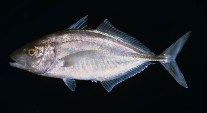
Dorsal spines (total): 9-9; Dorsal soft rays (total): 23-25; Anal spines: 3-3; Anal soft rays: 21-24. Bluish grey to green above, silvery white below; soft dorsal and anal fins with submarginal brownish band, fin lobes white distally (Ref. 3197). LL with 22-23 scutes. |
| Biology: |
Adults are found on the continental shelf and slope (Ref. 30573). Benthopelagic (Ref. 58302). Utilized as a food fish (Ref. 3287). Cultured and released for fishery in Japan. Minimum depth reported taken from Ref. 9773. |
| IUCN Red List Status: |
Least Concern (LC); Date assessed: 06 March 2015 Ref. (130435)
|
| Threat to humans: |
harmless |
Source and more info: www.fishbase.org. For personal, classroom, and other internal use only. Not for publication.