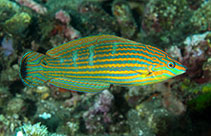
| Family: |
Labridae (Wrasses), subfamily: Julidinae |
| Max. size: |
14 cm TL (male/unsexed) |
| Environment: |
reef-associated; marine; depth range 1 - 15 m |
| Distribution: |
Indo-Pacific: from Bali, Indonesia and Western Australia to Micronesia and Samoa; north to Japan; south to Australia. |
| Diagnosis: |
Dorsal spines (total): 9-9; Dorsal soft rays (total): 11-12; Anal spines: 3-3; Anal soft rays: 11-12; Vertebrae: 25-25. Stripes on male body blue-green and orangish in life, becoming salmon pink and green anteriorly; a dark spot behind eye contained within a brown band that bifurcates posteriorly. Females with a small black spot on 1st interspinous membrane of dorsal fin, another between 2nd-3rd soft rays; a spot at the upper base of caudal fin. Anterior lateral line scales with 1-4 pores (usually 2). Pelvic fins of males reaching to or beyond the anus. |
| Biology: |
Found mostly on shallow coral reefs and rocky shores (Ref. 9823). Found solitary or in small groups on sheltered reefs over 15 m depth (Ref. 90102). Feed on small invertebrates such as polychaetes, copepods, isopods and forams (Ref. 1602). |
| IUCN Red List Status: |
Least Concern (LC); Date assessed: 12 June 2008 Ref. (130435)
|
| Threat to humans: |
harmless |
Source and more info: www.fishbase.org. For personal, classroom, and other internal use only. Not for publication.