
|
Exallodontus aguanai Lundberg, Mago-Leccia & Nass, 1991 |
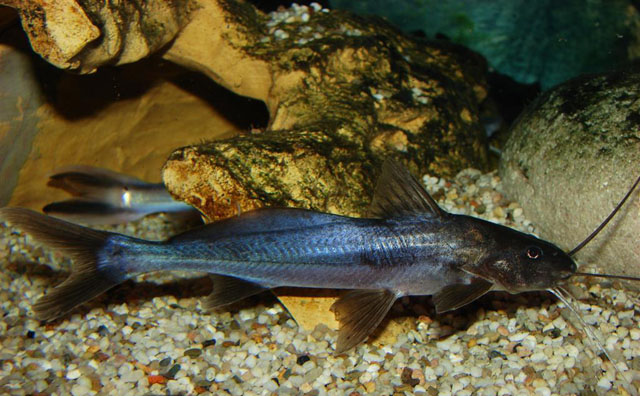
|
|
photo by
Ros, W. |
| Family: | Pimelodidae (Long-whiskered catfishes) | |||
| Max. size: | 20 cm SL (male/unsexed) | |||
| Environment: | demersal; freshwater; depth range 20 - 30 m | |||
| Distribution: | South America: Amazon and Orinoco River basins. | |||
| Diagnosis: | Dorsal spines (total): 2-2; Dorsal soft rays (total): 6-6; Anal soft rays: 11-14; Vertebrae: 46-50. Distinguished by having 2-3 rows of heavy, firmly attached conical teeth on premaxillae and dentaries; lacrimal (= infraorbital 1+2) shaped as an obtuse-angled triangle with nearly straight sides; relatively long, nearly straight-margined adipose fin (its length 2.0-2.5 in SL); short dorsal fin spine, low dorsal fin (spine length 5.6-8.6 in SL); relatively small head (head length 4.0-5.2 times in SL); small eye (horizontal diameter 3.4-5.5 times in snout length, 7.4-12.0 times in head length); neural spines of vertebrae 13 or 14 - 23 or 24 oriented 90°to horizontal axis of centra; supraoccipital process with a narrow median keel above somewhat concave sides, markedly angular in cross-section, slender and tapering to its peg-and-socket joint with supraneural (basal width of supraoccipital process about 2 times in length); anterior anal-fin rays broad, forming a paddle-like blade; posterior nostril ovoid, its long axis oriented transversely (Ref. 57763). | |||
| Biology: | ||||
| IUCN Red List Status: | Least Concern (LC); Date assessed: 21 December 2020 Ref. (130435) | |||
| Threat to humans: | harmless | |||