| Family: |
Bathymasteridae (Ronquils) |
| Max. size: |
38 cm TL (male/unsexed); max.weight: 370.0 g; max. reported age: 9 years |
| Environment: |
demersal; marine; depth range 0 - 825 m |
| Distribution: |
Arctic, Northwest to Northeast Pacific: East Siberian Sea to eastern Kamchatka and the Commander Islands, Russian and Washington, USA (Ref. 6793); including Hokkaido, Japan (Ref. 37422) and the Sea of Okhotsk (Ref. 48889). |
| Diagnosis: |
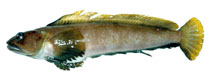
Dorsal spines (total): 0-0; Dorsal soft rays (total): 47; Anal spines: 0-0; Anal soft rays: 32-34. Caudal fin narrow, gently rounded (Ref. 6885). Brown on the dorsal surface with dark markings, lighter ventrally with yellow to orange streaks; yellow on head in some areas and yellow mottling on fins; black blotch on anterior part of dorsal fin for first 3 to 5 rays, conspicuous; pelvic fins dusky and some dark marks on other fins; eyes reputed to be blue (Ref. 6885). |
| Biology: |
Adults are found offshore on soft bottoms (Ref. 2850); and deeper (to 300 m) than other ronquils (Ref. 48889). Reaches more than 38 cm (Ref. 48889). |
| IUCN Red List Status: |
Not Evaluated (N.E.) Ref. (130435)
|
| Threat to humans: |
harmless |
Source and more info: www.fishbase.org. For personal, classroom, and other internal use only. Not for publication.