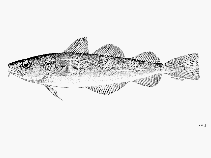
Teleostei (teleosts) >
Gadiformes (Cods) >
Gadidae (Cods and haddocks)
Etymology: Microgadus: Greek, mikros = samll + Latin, gadus = a fish, cod? (Ref. 45335); proximus: From the Latin 'proximus' meaning next (Ref. 6885).
More on author: Girard.
Environment: milieu / climate zone / depth range / distribution range
Ecology
Marine; brackish; demersal; oceanodromous (Ref. 51243); depth range 0 - 275 m (Ref. 1371), usually 25 - 120 m (Ref. 1371). Temperate; 62°N - 36°N, 179°W - 121°W (Ref. 1371)
Eastern Pacific: southeastern Bering Sea to central California, USA.
Size / Weight / Age
Maturity: Lm ? range ? - ? cm
Max length : 30.5 cm SL male/unsexed; (Ref. 27436)
Generally found over sand (Ref. 1371). May enter brackish water (Ref. 1371). Young move into shallow waters in summer and fall, whereas adults usually stay in deeper waters (Ref. 28499). Feeds on shrimps, amphipods, isopods, gastropods, mussels and fishes (Ref. 1371). An important prey species (Ref. 2850).
Oviparous, sexes are separate (Ref. 205).
Cohen, D.M., T. Inada, T. Iwamoto and N. Scialabba, 1990. FAO species catalogue. Vol. 10. Gadiform fishes of the world (Order Gadiformes). An annotated and illustrated catalogue of cods, hakes, grenadiers and other gadiform fishes known to date. FAO Fish. Synop. 125(10). Rome: FAO. 442 p. (Ref. 1371)
IUCN Red List Status (Ref. 130435)
Threat to humans
Harmless
Human uses
Fisheries: minor commercial; gamefish: yes
Tools
Special reports
Download XML
Internet sources
Estimates based on models
Preferred temperature (Ref.
123201): 3.4 - 9.5, mean 5.8 °C (based on 253 cells).
Phylogenetic diversity index (Ref.
82804): PD
50 = 0.7500 [Uniqueness, from 0.5 = low to 2.0 = high].
Bayesian length-weight: a=0.00794 (0.00418 - 0.01508), b=3.10 (2.94 - 3.26), in cm total length, based on LWR estimates for this (Sub)family-body shape (Ref.
93245).
Trophic level (Ref.
69278): 3.6 ±0.59 se; based on food items.
Resilience (Ref.
120179): Medium, minimum population doubling time 1.4 - 4.4 years (tm=2).
Fishing Vulnerability (Ref.
59153): Low to moderate vulnerability (27 of 100).
Climate Vulnerability (Ref.
125649): Moderate to high vulnerability (51 of 100).
Nutrients (Ref.
124155): Calcium = 46.3 [26.3, 97.9] mg/100g; Iron = 0.399 [0.223, 0.672] mg/100g; Protein = 18 [17, 19] %; Omega3 = 0.763 [0.383, 1.545] g/100g; Selenium = 13.2 [6.8, 30.3] μg/100g; VitaminA = 14.2 [4.1, 50.1] μg/100g; Zinc = 0.682 [0.480, 0.994] mg/100g (wet weight);