Environment: milieu / climate zone / depth range / distribution range
Ecology
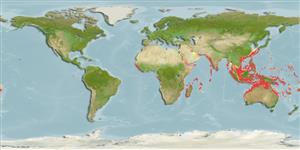
Marine; brackish; reef-associated; depth range 15 - 217 m (Ref. 86942). Tropical; 31°N - 31°S, 20°W - 177°W
Indo-Pacific: Red Sea and coast of East Africa to the Marshall Islands and Fiji, south to northern Australia (Ref. 2334). Eastern Atlantic: Senegal, Guinea, and Côte d'Ivoire (Ref. 4438).
Length at first maturity / Size / Weight / Age
Maturity: Lm ?, range 100 - ? cm
Max length : 147 cm WD male/unsexed; (Ref. 58048)
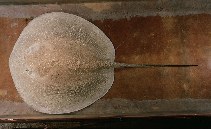
Diagnosis: A heavily armored stingray lacking a venomous barb; young with large, flat denticles on upper surface, and large juveniles and adults with additional sharp conical thorns and small, pointed denticles (Ref. 5578).
Inhabits the continental shelf area (Ref. 2334), but capable of entering coastal lagoons (Ref. 81259). Found on sand and coral rubble areas near reefs (Ref. 9840), often in caves. Ovoviviparous (Ref. 50449). Due to its difficult handling, it is probably of limited commercial value (Ref. 9840). Its thorn can inflict a painful injury; caught commonly by demersal tangle net fisheries; utilized for its meat, skin (very high value) and cartilage (Ref.58048).
Life cycle and mating behavior
Maturity | Reproduction | Spawning | Eggs | Fecundity | Larvae
Exhibit ovoviparity (aplacental viviparity), with embryos feeding initially on yolk, then receiving additional nourishment from the mother by indirect absorption of uterine fluid enriched with mucus, fat or protein through specialised structures (Ref. 50449). Distinct pairing with embrace (Ref. 205). Distinct pairing with embrace (Ref. 205).
Randall, J.E., G.R. Allen and R.C. Steene, 1990. Fishes of the Great Barrier Reef and Coral Sea. University of Hawaii Press, Honolulu, Hawaii. 506 p. (Ref. 2334)
IUCN Red List Status (Ref. 130435)
Threat to humans
Traumatogenic (Ref. 2334)
Human uses
Fisheries: commercial
More information
ReferencesAquacultureAquaculture profileStrainsGeneticsElectrophoresesHeritabilityDiseasesProcessingNutrientsMass conversion
Tools
Special reports
Download XML
Internet sources
Estimates based on models
Preferred temperature (Ref.
123201): 25.4 - 29.3, mean 28.5 °C (based on 2874 cells).
Phylogenetic diversity index (Ref.
82804): PD
50 = 0.5156 [Uniqueness, from 0.5 = low to 2.0 = high].
Bayesian length-weight: a=0.00832 (0.00366 - 0.01891), b=3.10 (2.90 - 3.30), in cm total length, based on LWR estimates for this (Sub)family-body shape (Ref.
93245).
Trophic level (Ref.
69278): 3.5 ±0.46 se; based on food items.
Resilience (Ref.
120179): Low, minimum population doubling time 4.5 - 14 years (Assuming fecundity<100).
Fishing Vulnerability (Ref.
59153): Very high vulnerability (90 of 100).
Nutrients (Ref.
124155): Calcium = 5.12 [0.57, 77.92] mg/100g; Iron = 0.354 [0.028, 3.818] mg/100g; Protein = 21.4 [18.7, 24.1] %; Omega3 = 0.0888 [, ] g/100g; Selenium = 41.6 [7.4, 202.0] μg/100g; VitaminA = 20.7 [1.8, 237.0] μg/100g; Zinc = 0.791 [0.052, 9.041] mg/100g (wet weight);