Teleostei (teleosts) >
Aulopiformes (Grinners) >
Synodontidae (Lizardfishes) > Synodontinae
Etymology: Synodus: Greek, syn, symphysis = grown together + Greek, odous = teeth (Ref. 45335); dermatogenys: Name from latin meaning unfading; referring to the markings on the pelvic fins that persist even in preserved specimens..
More on author: Fowler.
Environment: milieu / climate zone / depth range / distribution range
Ecology
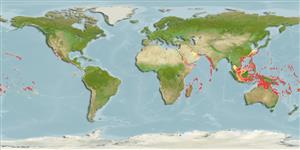
Marine; reef-associated; depth range 1 - 91 m (Ref. 86942). Tropical; 30°N - 32°S
Indo-Pacific: Red Sea to the Hawaiian, Line, Marquesan, and Tuamoto islands, north to Ryukyu Islands, south to Lord Howe; including Micronesia (Ref. 2334). Range extend to Southeast Atlantic, Algoa Bay, South Africa (Ref. 11228). Most authors misidentified this species as Synodus variegatus (Lacepède).
Size / Weight / Age
Maturity: Lm ? range ? - ? cm
Max length : 24.0 cm TL male/unsexed; (Ref. 11228)
Dorsal
spines
(total): 0;
Dorsal
soft rays
(total): 11-13;
Anal
spines: 0;
Anal
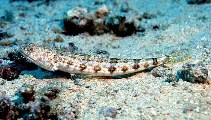
soft rays: 8 - 10. Body brownish above, with 7 irregular blackish bars (Ref. 11228). Cheek usually not scaled to preopercular margin; membranous flap on anterior nostrils long and slender; pectoral fins not reaching a line connecting origins of dorsal and pelvic fins.
Common on sand or sand-rubble areas of lagoon and seaward reefs to over 20 m depth (Ref. 1602, 9710, 48635). Benthic (Ref. 58302). Feeds on shrimps and small fishes (Ref. 89972). Frequently buries in sand leaving only eyes and nostrils exposed (Ref. 9710, 48635). Generally solitary (Ref. 1602). Sometimes in pairs or small groups (Ref 90102).
Life cycle and mating behavior
Maturity | Reproduction | Spawning | Eggs | Fecundity | Larvae
Generally solitary, but up to four males may have been observed courting a single larger female. A courting male may station itself atop a female and puff out its opercula and spread its fins in a display of aggression towards other males (Ref. 37816).
Randall, J.E., G.R. Allen and R.C. Steene, 1990. Fishes of the Great Barrier Reef and Coral Sea. University of Hawaii Press, Honolulu, Hawaii. 506 p. (Ref. 2334)
IUCN Red List Status (Ref. 130435)
Threat to humans
Harmless
Human uses
More information
ReferencesAquacultureAquaculture profileStrainsGeneticsElectrophoresesHeritabilityDiseasesProcessingNutrientsMass conversion
Tools
Special reports
Download XML
Internet sources
Estimates based on models
Preferred temperature (Ref.
123201): 24.3 - 28.8, mean 27.5 °C (based on 750 cells).
Phylogenetic diversity index (Ref.
82804): PD
50 = 0.5000 [Uniqueness, from 0.5 = low to 2.0 = high].
Bayesian length-weight: a=0.00617 (0.00387 - 0.00981), b=3.22 (3.09 - 3.35), in cm total length, based on LWR estimates for this species & Genus-body shape (Ref.
93245).
Trophic level (Ref.
69278): 4.2 ±0.7 se; based on diet studies.
Resilience (Ref.
120179): High, minimum population doubling time less than 15 months (Preliminary K or Fecundity.).
Fishing Vulnerability (Ref.
59153): Low vulnerability (14 of 100).
Nutrients (Ref.
124155): Calcium = 64.1 [23.5, 135.4] mg/100g; Iron = 0.578 [0.199, 1.239] mg/100g; Protein = 15.8 [12.9, 18.2] %; Omega3 = 0.0675 [, ] g/100g; Selenium = 34.7 [13.6, 80.4] μg/100g; VitaminA = 109 [28, 357] μg/100g; Zinc = 1.02 [0.59, 1.55] mg/100g (wet weight);