Teleostei (teleosts) >
Ovalentaria/misc (Various families in series Ovalentaria) >
Pomacentridae (Damselfishes) > Microspathodontinae
Etymology: Stegastes: Greek, stegastos, -e, -on = covered (Ref. 45335).
More on authors: Müller & Troschel.
Environment: milieu / climate zone / depth range / distribution range
Ecology
Marine; reef-associated; non-migratory; depth range 0 - 10 m (Ref. 27000). Tropical; 33°N - 35°S, 98°W - 31°W
Western Atlantic: including southern Florida (USA), Bermuda, and northern Gulf of Mexico to Brazil.
Size / Weight / Age
Maturity: Lm ? range ? - ? cm
Max length : 10.0 cm TL male/unsexed; (Ref. 9710)
Dorsal
spines
(total): 12;
Dorsal
soft rays
(total): 13-16;
Anal
spines: 2;
Anal
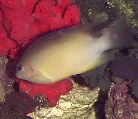
soft rays: 12 - 14. Caudal fin slightly forked, with rounded lobes. Dark blue or brown above, yellow below, without obvious narrow vertical lines. Dark spot near back of dorsal fin well above its base becomes smaller in larger fish (Ref. 26938).
Adults occur in seagrass beds, coral or rocky reefs and sandy areas. Also found around mangrove shores and sponge beds; less common on flourishing coral reefs (Ref. 26938). They remain within 50 cm from the substrate. Adults feed on algae, polychaetes, amphipods, foraminiferans and gastropods while juveniles feed on harpacticoid copepods, nemerteans and polychaetes (Ref. 9626). Oviparous, distinct pairing during breeding (Ref. 205). Eggs are demersal and adhere to the substrate (Ref. 205). Males guard and aerate the eggs (Ref. 205). Caught incidentally in traps and small-meshed beach nets (Ref. 5217).
Life cycle and mating behavior
Maturity | Reproduction | Spawning | Eggs | Fecundity | Larvae
Oviparous, distinct pairing during breeding (Ref. 205). Males guard and aerate the eggs (Ref. 205). The eggs are deposited inside empty shells or under stones or shell (Ref. 39478).
Allen, G.R., 1991. Damselfishes of the world. Mergus Publishers, Melle, Germany. 271 p. (Ref. 7247)
IUCN Red List Status (Ref. 130435)
Threat to humans
Harmless
Human uses
Aquarium: commercial
More information
ReferencesAquacultureAquaculture profileStrainsGeneticsElectrophoresesHeritabilityDiseasesProcessingNutrientsMass conversion
Tools
Special reports
Download XML
Internet sources
Estimates based on models
Preferred temperature (Ref.
123201): 26.2 - 28.2, mean 27.5 °C (based on 586 cells).
Phylogenetic diversity index (Ref.
82804): PD
50 = 0.5000 [Uniqueness, from 0.5 = low to 2.0 = high].
Bayesian length-weight: a=0.01950 (0.01192 - 0.03189), b=2.95 (2.81 - 3.09), in cm total length, based on LWR estimates for this species & Genus-body shape (Ref.
93245).
Trophic level (Ref.
69278): 3.1 ±0.2 se; based on diet studies.
Resilience (Ref.
120179): High, minimum population doubling time less than 15 months (Preliminary K or Fecundity.).
Fishing Vulnerability (Ref.
59153): Low vulnerability (10 of 100).
Nutrients (Ref.
124155): Calcium = 124 [63, 196] mg/100g; Iron = 0.779 [0.462, 1.295] mg/100g; Protein = 18.4 [17.3, 19.5] %; Omega3 = 0.11 [0.06, 0.18] g/100g; Selenium = 18.8 [10.4, 36.2] μg/100g; VitaminA = 95.9 [28.1, 308.4] μg/100g; Zinc = 1.72 [1.15, 2.52] mg/100g (wet weight);