Teleostei (teleosts) >
Cichliformes (Cichlids, convict blennies) >
Cichlidae (Cichlids) > Pseudocrenilabrinae
Etymology: Copadichromis: Greek, kopas, -ados = carved + Chromis, see.
Environment: milieu / climate zone / depth range / distribution range
Ecology
Freshwater; benthopelagic, usually 19 - 25 m (Ref. 57549). Tropical; 12°S - 15°S
Africa: Endemic to Lake Malawi. Occurs on the southern half of the lake (Mbenji Islands Nakatenga and Maleri Islands, Nkhomo Reef near Benga and Eccles Reef south of Makanjila, on the eastern coast).
Size / Weight / Age
Maturity: Lm ? range ? - ? cm
Max length : 14.6 cm TL male/unsexed; (Ref. 4979)
Dorsal
spines
(total): 15 - 18;
Dorsal
soft rays
(total): 10-12;
Anal
spines: 3;
Anal
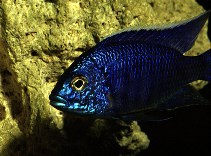
soft rays: 8 - 9. Diagnosis: 3 lateral spots on the body; supra-pectoral spot about 1.5 times the supra-anal spot; supra-pectoral spot separate from upper lateral line; supra-anal spot smaller than 2 scales; males in breeding coloration with blue breast, narrow yellow marginal band in anal fin and without spots or streaks in the anal fin (Ref. 57549).
Inhabits the sand/rock interface; territorial males defend their bower with a bowl in front of a spawning cave that spans about half a circle or less, about 19-33cm in diameter; females gather in small groups or are solitary, and feed from the plankton and benthic invertebrates near the bottom (Ref. 57549). Aquarium trade names: 'Haplochromis chrysonotus mbenji', 'Haplochromis chrysonotus maleri' (Ref. 5595).
Life cycle and mating behavior
Maturity | Reproduction | Spawning | Eggs | Fecundity | Larvae
Stauffer, J.R. and A.F. Konings, 2006. Review of Copadichromis (Teleostei: Cichlidae) with the description of a new genus and six new species. Ichthyol. Explor. Freshwat. 17(1):9-42. (Ref. 57549)
IUCN Red List Status (Ref. 130435)
Threat to humans
Harmless
Human uses
Aquarium: commercial
More information
Common namesSynonymsMetabolismPredatorsEcotoxicologyReproductionMaturitySpawningSpawning aggregationFecundityEggsEgg development
Age/SizeGrowthLength-weightLength-lengthLength-frequenciesMorphometricsMorphologyLarvaeLarval dynamicsRecruitmentAbundanceBRUVS
ReferencesAquacultureAquaculture profileStrainsGeneticsElectrophoresesHeritabilityDiseasesProcessingNutrientsMass conversion
Tools
Special reports
Download XML
Internet sources
Estimates based on models
Phylogenetic diversity index (Ref.
82804): PD
50 = 0.5000 [Uniqueness, from 0.5 = low to 2.0 = high].
Bayesian length-weight: a=0.01514 (0.00700 - 0.03275), b=2.97 (2.80 - 3.14), in cm total length, based on LWR estimates for this (Sub)family-body shape (Ref.
93245).
Trophic level (Ref.
69278): 3.4 ±0.45 se; based on food items.
Resilience (Ref.
120179): High, minimum population doubling time less than 15 months (Preliminary K or Fecundity.).
Fishing Vulnerability (Ref.
59153): Low vulnerability (10 of 100).