Teleostei (teleosts) >
Acanthuriformes (Surgeonfishes) >
Pomacanthidae (Angelfishes)
Etymology: Pomacanthus: Greek, poma, -atos = cover, operculum + Greek, akantha = thorn (Ref. 45335).
More on author: Bloch.
Environment: milieu / climate zone / depth range / distribution range
Ecology
Marine; reef-associated; non-migratory; depth range 1 - 100 m (Ref. 48391). Tropical; 31°N - 28°S, 32°E - 144°W
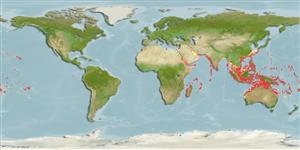
Indo-Pacific: Red Sea and East Africa to Line and Tuamoto islands, North to southern Japan and the Ogasawara Islands, South to the Great Barrier Reef, New Caledonia, and the Austral Islands (Ref. 33390). Mention from Hawaii Is., but likely to be aquarium releases (Ref. 58302). Not found in Easter Island, Rapa and the Marquesan Islands (Ref. 48391).
Length at first maturity / Size / Weight / Age
Maturity: Lm 25.0 range ? - ? cm
Max length : 40.0 cm SL male/unsexed; (Ref. 30573); max. reported age: 14 years (Ref. 72479)
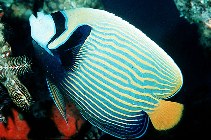
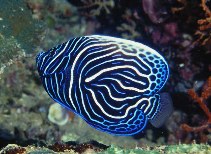
Juveniles are encountered under ledges, or in holes of outer lagoon patch reefs or semi-protected areas of exposed channels and outer reef flats. Subadults move to reef front holes and surge channels. Large adults inhabit ledges and caves in areas of rich coral growth on clear lagoon, channel, or seaward reefs (Ref. 6113). Benthopelagic (Ref. 58302). Feed on sponges and other encrusting organisms (Ref. 6113); also on tunicates. Form pairs. Young and adults may clean much larger fishes such as sunfish (Ref. 48636). Frequently exported through the aquarium trade. Juveniles are distinguished by a white dorsal-fin margin (Ref. 48391).
Myers, R.F., 1991. Micronesian reef fishes. Second Ed. Coral Graphics, Barrigada, Guam. 298 p. (Ref. 1602)
IUCN Red List Status (Ref. 130435)
Threat to humans
Harmless
Human uses
Fisheries: minor commercial; aquarium: commercial
More information
ReferencesAquacultureAquaculture profileStrainsGeneticsElectrophoresesHeritabilityDiseasesProcessingNutrientsMass conversion
Tools
Special reports
Download XML
Internet sources
Estimates based on models
Preferred temperature (Ref.
123201): 24.6 - 29, mean 27.9 °C (based on 1496 cells).
Phylogenetic diversity index (Ref.
82804): PD
50 = 0.5001 [Uniqueness, from 0.5 = low to 2.0 = high].
Bayesian length-weight: a=0.02512 (0.01462 - 0.04317), b=2.87 (2.73 - 3.01), in cm total length, based on LWR estimates for this species & Genus-body shape (Ref.
93245).
Trophic level (Ref.
69278): 2.7 ±0.00 se; based on food items.
Generation time: 16.4 ( na - na) years. Estimated as median ln(3)/K based on 1
growth studies.
Resilience (Ref.
120179): Very Low, minimum population doubling time more than 14 years (Preliminary K or Fecundity.).
Fishing Vulnerability (Ref.
59153): High to very high vulnerability (68 of 100).
Nutrients (Ref.
124155): Calcium = 36.1 [16.0, 61.1] mg/100g; Iron = 0.475 [0.267, 0.836] mg/100g; Protein = 18 [17, 19] %; Omega3 = 0.0941 [, ] g/100g; Selenium = 39.9 [18.9, 92.0] μg/100g; VitaminA = 68 [14, 303] μg/100g; Zinc = 1.4 [0.9, 2.1] mg/100g (wet weight);