Environment: milieu / climate zone / depth range / distribution range
Ecology
Marine; reef-associated; depth range 2 - 35 m (Ref. 9710). Temperate
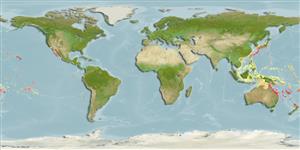
Southwest Pacific: Australia and New Zealand. Range extends eastward to Easter Island (Ref. 9710).
Size / Weight / Age
Maturity: Lm ? range ? - ? cm
Max length : 29.0 cm TL male/unsexed; (Ref. 9710)
Dorsal
spines
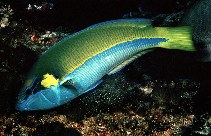
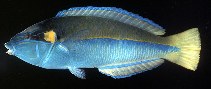
(total): 8 - 10. Body color light brown with a faint blue spot, 1 per scale, above lateral line and 7 faint golden stripes following centers of scale rows below lateral line; a faint dark stripe from front of snout to eye with a fainter continuation behind eye; lower half of head pale silvery. Pectoral fin comparatively long (1.5-1.7 times in HL) (Ref. 9823).
Adults are primarily found in lagoons (Ref. 9710). Also in coastal reef areas. Feed on a variety of invertebrates. Females in groups of up to 80 or more, males territorial (Ref. 9710). Oviparous, distinct pairing during breeding (Ref. 205).
Life cycle and mating behavior
Maturity | Reproduction | Spawning | Eggs | Fecundity | Larvae
Oviparous, distinct pairing during breeding (Ref. 205).
Randall, J.E., 1972. A revision of the labrid fish genus Anampses. Micronesica 8(1-2):151-190. (Ref. 2677)
IUCN Red List Status (Ref. 130435)
Threat to humans
Harmless
Human uses
Fisheries: of no interest; aquarium: commercial
More information
ReferencesAquacultureAquaculture profileStrainsGeneticsElectrophoresesHeritabilityDiseasesProcessingNutrientsMass conversion
Tools
Special reports
Download XML
Internet sources
Estimates based on models
Preferred temperature (Ref.
123201): 20.5 - 29.2, mean 28.1 °C (based on 2296 cells).
Phylogenetic diversity index (Ref.
82804): PD
50 = 0.5002 [Uniqueness, from 0.5 = low to 2.0 = high].
Bayesian length-weight: a=0.00977 (0.00470 - 0.02030), b=3.07 (2.89 - 3.25), in cm total length, based on LWR estimates for this (Sub)family-body shape (Ref.
93245).
Trophic level (Ref.
69278): 3.5 ±0.37 se; based on food items.
Resilience (Ref.
120179): Medium, minimum population doubling time 1.4 - 4.4 years (Preliminary K or Fecundity.).
Fishing Vulnerability (Ref.
59153): Low vulnerability (19 of 100).
Nutrients (Ref.
124155): Calcium = 19.2 [7.9, 34.1] mg/100g; Iron = 0.207 [0.112, 0.441] mg/100g; Protein = 18.8 [15.9, 21.0] %; Omega3 = 0.367 [0.198, 0.695] g/100g; Selenium = 5.97 [2.75, 13.34] μg/100g; VitaminA = 77.1 [19.5, 368.3] μg/100g; Zinc = 0.691 [0.452, 1.241] mg/100g (wet weight);