Petromyzonti (lampreys) >
Petromyzontiformes (Lampreys) >
Petromyzontidae (Northern lampreys) > Petromyzontinae
Etymology: Petromyzon: petra (Gr.), rock or stone; myzon (Gr.), to suck, referring to their suctorial behavior (adults attach to rocks during nest building and mating). (See ETYFish); marinus: Latin for “of the sea,” referring to its marine habitat (as a non-breeding adult) [see box, next page]. (See ETYFish).
More on author: Linnaeus.
Environment: milieu / climate zone / depth range / distribution range
Ecology
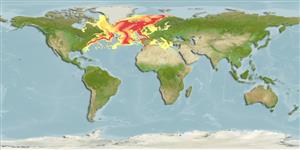
Marine; freshwater; brackish; demersal; anadromous (Ref. 89241); depth range 1 - 4099 m (Ref. 47198). Temperate; 1°C - 20°C (Ref. 88713); 72°N - 25°N, 82°W - 27°E
Northeast Atlantic: Norway including Iceland and the Barents Sea, south to northern Africa. Throughout the western and central Mediterranean but absent from eastern Mediterranean and the Black Sea (Ref. 59043). Western Atlantic: Labrador, Canada to Gulf of Mexico in Florida, USA. Landlocked in Great Lakes, Finger Lakes, Oneida Lake and Lake Champlain, Canada/USA (Ref. 12269). Gulf of St. Lawrence to St. Jonhs River in Florida, St. Lawrence-Great Lakes basin; 1 record for Florida panhandle (Ref. 86798).
Size / Weight / Age
Maturity: Lm ? range ? - ? cm
Max length : 120 cm TL male/unsexed; (Ref. 86798); common length : 60.0 cm TL male/unsexed; (Ref. 4645); max. published weight: 2.5 kg (Ref. 5504); max. reported age: 11 years (Ref. 12324)
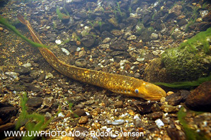
Vertebrae: 0. Anguilliform body (Ref. 51442). Jawless with a round sucker-like mouth and sharp teeth arranged in many consecutive circular rows (Ref. 88171). Presence of 7 branchial openings behind the eye (Ref. 51442, 88171). Lacks paired fins (Ref. 88171). Number of myomeres: 67-74 (Ref. 6258, 89241). Olive or brown-yellow on the dorsal and lateral part of the body, with black marblings; becomes lighter ventrally (Ref. 35388, 51442, 58137). Back, side and fins with prominent black mottling; oral disc as wide or wider than head (Ref. 86798). Adults: 11.4-120.0 cm TL. Body wet weight of the 120 cm TL individual was 2.3 kg. Maximum size attained by landlocked populations in the Laurentian Great Lakes, 60 cm TL. Body proportions, as percentage of TL (based on a variable number of specimens and sizes as indicated after the ranges): prebranchial length, 9.2-16.0 (in 46 specimens 19.2-82.75 cm TL); branchial length, 8.1-16.0 (in 46 specimens 19.2-82.75 cm TL); trunk length, 45.6-58.5 (in 42 specimens 25.6-82.75 cm TL); tail length, 22.0-42.2 (in 46 specimens 19.2-82.75 cm TL); eye length, 0.8-3.6 (in 49 specimens 13.5-82.75 cm TL); disc length, 4.5-9.3 (in 58 specimens 13.5-83.5 cm TL); snout length, 6.5-10.9 (in 41 specimens 25.6-82.75 cm TL). Urogenital papilla length, as a percentage of branchial length, in seven spawning males measuring 38.5-49.2 cm TL, 9.5-13.0. Spawning males develop a rope-like dorsal ridge ahead of the first dorsal fin and extending to the level of the posterior part of the branchial region, and hence, are sometimes called corded males. Dentition: supraoral lamina, 1 bicuspid tooth; infraoral lamina, 6-10 unicuspid teeth, the lateralmost sometimes bicuspid; 4 endolaterals on each side; endolateral formula, typically 2-2-2-2; 3 rows of anterials; first row of anterials, 1 unicuspid tooth; 5-7 rows of exolaterals on each side; 3 rows of posterials; first row of posterials, 10 unicuspid teeth; transverse lingual lamina strongly w-shaped, with 12-14 cusps, the median one not enlarged; longitudinal lingual laminae j-shaped, each with 12-14 cusps. Moderately well-developed marginal membrane. Velar tentacles, 2-3, smooth. Body coloration (preserved), newly-transformed individuals 13.5-17.5 cm TL have their colour grading from gray-bluish dorsally to silvery white ventrally while in individuals 45 cm TL or more the dorsal and lateral aspects become mottled and the ventral aspect remains uniformly pale. The iris is golden yellow. Lateral line neuromasts unpigmented or darkly pigmented. Extent of caudal fin pigmentation, 75% or more. Caudal fin shape, spade-like. Oral fimbriae, 114-150. Oral papillae, 24-33 (Ref. 89241).
Some populations are permanent freshwater residents [Laurentian Great Lakes, Finger Lakes (Lake Cayuga), Lake Champlain], while others are anadromous. Occupies a wide range of streams and habitats. Larvae are found in streams with summer flows 0.03-4,400 m3/s and summer water temperatures 10-26.1 °C. Relatively abundant in cool, pool-riffle streams with sand-gravel substrate, high water quality and stable flows, but is also tolerant of fluctuating flows. In Michigan, ammocoetes have been reported in lentic habitats up to 450 m from the presumed originating stream, at water depths 1-16 m, where substrates vary from sand-silt, with or without detritus, to gravel-rubble-sand. Feeding adults of permanent freshwater populations can be found in small to large lakes and large rivers and, in the case of anadromous populations, in small to large rivers and in the ocean. In the ocean, it occurs both pelagically and benthically, possibly to a depth of 4,099 m. Spawning adults can be found in creeks or lake inlets (Ref. 89241). Amphihaline species making important migrations. Spends its adult life in the sea for about 20-36 months, moving further offshore as it grows (Ref. 59043). Adults are parasitic, using their sharp teeth to attach themselves to cetaceans and large fish and feed off their host’s blood, body fluids and flesh for several days, usually without killing the host (Ref. 59043). An anticoagulant substance prevents the blood of the prey from clotting. Mature adults enter rivers and streams to spawn in spring (Ref. 12324, 35387, 88186). Movements from the sea to spawning sites may cover distances from 20-850 km inland (Ref. 12324). After spawning adults normally die (Ref. 51442). Ammocoetes drift downstream and bury in detritus-rich mud, silt or sand-silt bottoms (Ref. 59043, 88712) for 5.5-8 years, often at the edges of rivers and streams where currents are slow (Ref. 58185, 59043, 88184). Duration of larval life is usually a minimum of 5 yrs, but has been reported as short as 2 years and as long as 19 or more years (Ref. 89241). Ammocoetes are filter feeders of diatoms and detritus (Ref. 30578, 51442, 59043). Upon metamorphosis, individuals move downstream towards the sea. Juveniles remain in the estuaries and shallow coastal areas for a feeding period lasting 23-28 months, during which they grow from ca. 4 to 900 g (Ref. 58185, 88171). Most individuals attain 60-75 cm length (Ref. 88187). Duration of adult life in anadromous populations approximately two years. Metamorphosis occurs in July-October, but has been reported as early as April, in Michigan. Adults are parasitic on marine and freshwater fishes, and marine mammals. Multiple attachments can occur (e.g., 3 on Cetorhinus maximus, 2-3 on Urophycis chuss). Adults are preyed upon by Porbeagle Sharks in northwestern Atlantic waters. Feeding migrations in landlocked parasitic adults in the Laurentian Great Lakes can reach 628 km (Ref. 89241). They may not only feed on dead or netted fish, but also attach themselves to healthy fish. The landlocked form is very destructive to freshwater fishes and occasionally annoys bathers by clinging to them (Ref. 51442). In Michigan, the spawning period is from 27 May to 2 September, at water temperatures between 11.1-26.1 °C, with peak spawning activity in late May to mid-June. In Ontario, nest building occurs from 4 to 21 June at water temperatures 18-23 °C. In Québec and New York streams spawning also occurs in June, but in New York lakes spawning is from the end of May to the beginning of July. Nests are built in streams having 1.5-43 m width, 15-90 cm depth, and 0.01-54 m3/s flow. Up to ten spawning lampreys have been found in a nest. Fecundity, 43,997-101,932 [up to 108,000 according to Gage (1928)] eggs/female in landlocked populations and 151,836-304,832 eggs/female in anadromous populations. There are reported occurrences in Michigan of communal spawning of Sea Lamprey with Chestnut Lamprey (Pine, Platte, and Muskegon rivers), of Sea Lamprey with Northern Brook Lamprey (Devils River), of Sea Lamprey with Silver Lamprey (Carp Lake, Devils, East Au Gres, and Rifle rivers), of Sea Lamprey with American Brook Lamprey (Carp Lake, Pine and Pentwater rivers), of Sea Lamprey with American Brook Lamprey and Chestnut Lamprey (Betsie River), and of Sea Lamprey with American Brook Lamprey and Silver Lamprey (Carp Lake). Invaded the upper Laurentian Great Lakes (Huron-Michigan-Superior) in the late 1930s, where it contributed to some extent to the collapse of the Lake Trout and various cisco (Coregonus johannae, C. nigripinnis, and C. zenithicus) fisheries. The fishes that did not die directly from the lamprey attacks or indirectly from secondary fungal infection had reduced market value because of the unsightly wounds. Splake, a fast-growing hybrid between Brook Trout and Lake Trout was developed specifically in response to the effect of Sea Lamprey on Lake Trout. Overfishing was also a major consideration in the demise of Lake Trout populations and Gilbertson (1992) has suggested that another contributing factor would be the extreme sensitivity of eggs and sac fry of this species to a persistent dioxin-like PCB isomer that was probably present in the Great Lakes by the 1930s and resulted in its reduced reproductive success. Sea Lamprey has been targeted by control measures in the Laurentian Great Lakes’ Basin that include lampricide treatments (3-trifluoromethyl-4-nitrophenol, abbreviated as TFM, with or without the synergist 2’,5-dichloro-4’-nitrosalicylanilide, abbreviated as Bayer 73) aimed at ammocoetes, beginning in 1957, electromechanical barriers that intercept upstream migrants, beginning before 1957, and later low-head barriers, adjustable-crest barriers, also known as inflatable barriers, traps, and chemosterilization of males. Approximately 258,000 adult Sea Lamprey, were taken between 1953 and 1960 at electrical barriers operated in Lake Superior Basin alone. Between 1958 and 1980, 54.5 million Canadian dollars where spent for Sea Lamprey control and research. Despite some attempts at developing a fishery oriented towards ethnic communities in large cities around the Great Lakes such as Toronto, a fishery for landlocked Sea Lamprey has not become established. Additionally, high levels of mercury in adults preclude their use for human consumption. Historical fisheries for the anadromous form existed in the 1800s on the Merrimack and Connecticut rivers, Massachusetts, when it was abundant, before dams and pollution. Such fisheries have existed for centuries in Europe [England (UK), France, Portugal]. Recipes include Lamproie à la bordelaise, which involves cooking in red wine. There are reports of intoxication through eating this species (Halstead, 1967) (Ref. 89241).
Mature adults ascend rivers during spring and early summer (Ref. 35387, 88186) when water temperature ranges from 10-18°C (Ref. 88184) and gather in small groups (Ref. 5504). Behavioural experiments suggest that mature sea lampreys can smell the presence of ammocoetes and use this as a guide to functional spawning grounds (Ref. 88714). Spawning occurs in fast-flowing highly oxygenated areas with gravel, pebbles and sand bottoms (Ref. 12324). Females release small eggs (< 1 mm diameter) in nests exclusively built by males, which have been observed to reach the spawning grounds first (Ref. 5504, 12324, 51442). Spawning takes place mostly during sunny days, when water temperature is at least 15°C (Ref. 88171). Ammocoetes hatch after 7-14 days (41851, 88186). Successful hatching requires water temperatures of 15-25°C (Ref. 88715). Ammocoetes develop in freshwater and migrate to the sea after metamorphosis (Ref. 5504). Also Ref. 30578, 51442.
Hardisty, M.W., 1986. Petromyzon marinus (Linnaeus 1758). p. 94-116. In J. Holcík (ed.) The Freshwater fishes of Europe. Vol. 1, Part 1. Petromyzontiformes. (Ref. 12324)
IUCN Red List Status (Ref. 130435)
Threat to humans
Harmless
Human uses
Fisheries: minor commercial
Tools
Special reports
Download XML
Internet sources
Estimates based on models
Preferred temperature (Ref.
123201): 1.8 - 13.1, mean 7.1 °C (based on 273 cells).
Phylogenetic diversity index (Ref.
82804): PD
50 = 1.0000 [Uniqueness, from 0.5 = low to 2.0 = high].
Bayesian length-weight: a=0.00107 (0.00040 - 0.00285), b=3.03 (2.81 - 3.25), in cm total length, based on LWR estimates for this (Sub)family-body shape (Ref.
93245).
Trophic level (Ref.
69278): 4.4 ±0.85 se; based on food items.
Resilience (Ref.
120179): Low, minimum population doubling time 4.5 - 14 years (tmax=11; K 0.16; tm=5-12; Relative Fec = 233).
Fishing Vulnerability (Ref.
59153): High to very high vulnerability (72 of 100).
Climate Vulnerability (Ref.
125649): Moderate to high vulnerability (47 of 100).
Nutrients (Ref.
124155): Calcium = 9.74 [2.86, 30.48] mg/100g; Iron = 0.275 [0.107, 0.937] mg/100g; Protein = 3.25 [0.00, 6.96] %; Omega3 = 0.62 [0.28, 1.45] g/100g; Selenium = 24 [7, 68] μg/100g; VitaminA = 13.6 [4.7, 42.7] μg/100g; Zinc = 0.364 [0.180, 0.700] mg/100g (wet weight);