Environment: milieu / climate zone / depth range / distribution range
Ecology
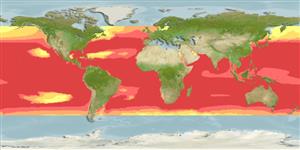
Marine; brackish; pelagic-oceanic; oceanodromous (Ref. 51243); depth range 1 - 1602 m, usually 1 - 250 m (Ref. 6390). Tropical; 15°C - 31°C (Ref. 168); 50°N - 50°S, 180°W - 180°E
Worldwide in tropical and subtropical seas, but absent from the Mediterranean Sea. Highly migratory species.
Length at first maturity / Size / Weight / Age
Maturity: Lm 103.3, range 78 - 158 cm
Max length : 239 cm FL male/unsexed; (Ref. 40637); common length : 150 cm FL male/unsexed; (Ref. 168); max. published weight: 200.0 kg (Ref. 26550); max. reported age: 9 years (Ref. 72462)
Dorsal
spines
(total): 11 - 14;
Dorsal
soft rays
(total): 12-16;
Anal
spines: 0;
Anal
soft rays: 11 - 16;
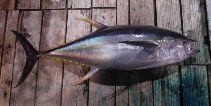
Vertebrae: 39. This large species is distinguished by the following characters: elongate, fusiform body, slightly compressed laterally; total gill rakers on first gill arch 26-34; dorsal fins 2 and separated only by a narrow interspace, the second followed by 8-10 finlets; anal fin followed by 7 to 10 finlets; large specimens may have very long second dorsal and anal fins, becoming well over 20% of fork length; pectoral fins moderately long, usually reaching beyond second dorsal-fin origin but not beyond end of its base, usually 22-31% of FL; 2 flaps (interpelvic process) between pelvic fins; body with very small scales; corselet of larger scales developed but not very distinct; caudal peduncle very slender, bearing on each side a strong lateral keel between 2 smaller keels; no striations on ventral surface of liver; swimbladder present. Colour of back metallic dark blue changing through yellow to silver on belly; belly frequently crossed by about 20 broken, nearly vertical lines; dorsal and anal fins, and dorsal and anal finlets bright yellow, the finlets with a narrow black border (Ref. 9684).
An oceanic species occurring above and below the thermoclines. Pelagic in open water , but rarely seen near reefs (Ref. 48637). They school primarily by size, either in monospecific or multi-species groups. Larger fish frequently school with porpoises, also associated with floating debris and other objects. Feed on fishes, crustaceans and squids. It is sensitive to low concentrations of oxygen and therefore is not usually caught below 250 m in the tropics (Ref. 28952, 30329). Peak spawning occurs during the summer, in batches (Ref. 9684, 51846). Eggs and larvae are pelagic (Ref. 6769). Encircling nets are employed to catch schools near the surface (Ref. 9340). Caught mainly with longlines and purse seines. Marketed mainly fresh, frozen, canned (Ref. 9684), but also smoked (Ref. 9987). Highly valued for sashimi (Ref. 26938).
Spawn throughout the tropical and equatorial waters of the major oceans (Ref. 6390). At higher latitudes, spawning is seasonal, with peaks in summer; may continue throughout the year at lower latitudes (Ref. 6390).
Yellowfin tuna are multiple spawners, ie they spawn every few days over the spawning period (Ref. 6390). Eggs and sperm are released into the water for fertilisation (Ref. 6390).
Collette, B.B. and C.E. Nauen, 1983. FAO Species Catalogue. Vol. 2. Scombrids of the world. An annotated and illustrated catalogue of tunas, mackerels, bonitos and related species known to date. Rome: FAO. FAO Fish. Synop. 125(2):137 p. (Ref. 168)
IUCN Red List Status (Ref. 130435)
Threat to humans
Harmless
Human uses
Fisheries: highly commercial; aquaculture: experimental; gamefish: yes
Tools
Special reports
Download XML
Internet sources
Estimates based on models
Preferred temperature (Ref.
123201): 16.5 - 28.9, mean 26.7 °C (based on 6382 cells).
Phylogenetic diversity index (Ref.
82804): PD
50 = 0.5039 [Uniqueness, from 0.5 = low to 2.0 = high].
Bayesian length-weight: a=0.01479 (0.01210 - 0.01808), b=3.03 (2.99 - 3.07), in cm total length, based on LWR estimates for this species (Ref.
93245).
Trophic level (Ref.
69278): 4.4 ±0.4 se; based on diet studies.
Generation time: 2.8 (2.3 - 3.5) years. Estimated as median ln(3)/K based on 46
growth studies.
Resilience (Ref.
120179): Medium, minimum population doubling time 1.4 - 4.4 years (K=0.13-0.42; tm=2-5; tmax=8; Fec=200,000).
Prior r = 0.57, 95% CL = 0.37 - 0.85, Based on 5 stock assessments.
Fishing Vulnerability (Ref.
59153): Moderate to high vulnerability (46 of 100).
Climate Vulnerability (Ref.
125649): Moderate vulnerability (42 of 100).
Nutrients (Ref.
124155): Calcium = 41 [22, 86] mg/100g; Iron = 2.84 [1.17, 6.68] mg/100g; Protein = 23.7 [22.2, 25.1] %; Omega3 = 0.274 [0.166, 0.457] g/100g; Selenium = 82.4 [21.0, 256.4] μg/100g; VitaminA = 29.6 [3.7, 227.6] μg/100g; Zinc = 0.524 [0.292, 0.972] mg/100g (wet weight); based on
nutrient studies.