Environment: milieu / climate zone / depth range / distribution range
Ecology
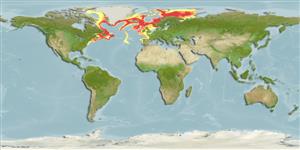
Marine; demersal; oceanodromous (Ref. 51243); depth range 50 - 2000 m (Ref. 4705). Temperate; 79°N - 36°N, 77°W - 55°E
Northwestern Atlantic: southwestern Greenland and Labrador in Canada to Virginia in USA (Ref. 7251); Northeastern Atlantic: Bay of Biscay to Spitsbergen, Barents Sea, Iceland and eastern Greenland.
Length at first maturity / Size / Weight / Age
Maturity: Lm 122.0, range 135 - ? cm
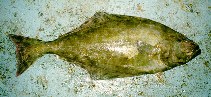
Max length : 470 cm TL male/unsexed; (Ref. 7251); 300.0 cm TL (female); max. published weight: 320.0 kg (Ref. 7251); max. reported age: 50 years (Ref. 173)
Adults are benthic but occasionally pelagic (Ref. 4705). Feed mainly on other fishes (cod, haddock, pogge, sand-eels, herring, capelin), but also takes cephalopods, large crustaceans and other bottom-living animals. Batch spawner (Ref. 51846). Growth rate varies according to density, competition and availability of food. Slow growth rate and late onset of sexual maturity, halibut populations can be seriously affected by overfishing (Ref. 35388). Utilized fresh, dried or salted, smoked and frozen; can be steamed, fried, broiled, boiled, microwaved and baked (Ref. 9988). Also Ref. 58426.
Males reach sexual maturity at 7-8 years and females at 10-11 years. Spawning happens from December to April, near the bottom (300 to 700 m), at temperatures between 5 and 7°. Egg size 3.0-3.8, larval size at hatching 6.5 mm (Ref. 4705).
Vinnikov, K.A., R.C. Thomson and T.A. Munroe, 2018. Revised classification of the righteye flounders (Teleostei: Pleuronectidae) based on multilocus phylogeny with complete taxon sampling. Molecular phylogenetics and evolution, 125:147-162. (Ref. 122998)
IUCN Red List Status (Ref. 130435)
Threat to humans
Harmless
Human uses
Fisheries: commercial; aquaculture: experimental; gamefish: yes; aquarium: public aquariums
Tools
Special reports
Download XML
Internet sources
Estimates based on models
Preferred temperature (Ref.
123201): 0.4 - 7.9, mean 3.4 °C (based on 1760 cells).
Phylogenetic diversity index (Ref.
82804): PD
50 = 0.7500 [Uniqueness, from 0.5 = low to 2.0 = high].
Bayesian length-weight: a=0.00550 (0.00398 - 0.00759), b=3.17 (3.08 - 3.26), in cm total length, based on LWR estimates for this species (Ref.
93245).
Trophic level (Ref.
69278): 4.0 ±0.5 se; based on diet studies.
Resilience (Ref.
120179): Very Low, minimum population doubling time more than 14 years (tmax=30; tm=10; K=0.02-0.2; Fec=1,300,000; also Musick et al. 2000 (Ref.
36717)).
Prior r = 0.47, 95% CL = 0.31 - 0.71, Based on 1 stock assessment.
Fishing Vulnerability (Ref.
59153): Very high vulnerability (88 of 100).
Climate Vulnerability (Ref.
125649): Moderate vulnerability (43 of 100).
Nutrients (Ref.
124155): Calcium = 5.62 [1.90, 13.84] mg/100g; Iron = 0.178 [0.067, 0.495] mg/100g; Protein = 17.9 [16.0, 20.4] %; Omega3 = 0.35 [0.14, 0.90] g/100g; Selenium = 57.8 [19.5, 148.9] μg/100g; VitaminA = 7.93 [1.78, 32.76] μg/100g; Zinc = 0.387 [0.168, 0.655] mg/100g (wet weight); based on
nutrient studies.