Teleostei (teleosts) >
Eupercaria/misc (Various families in series Eupercaria) >
Sillaginidae (Smelt-whitings)
Etymology: Sillaginodes: See Sillago + Greek, oides = similar to.
More on author: Cuvier.
Environment: milieu / climate zone / depth range / distribution range
Ecology
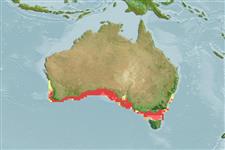
Marine; brackish; demersal; non-migratory; depth range 2 - 200 m (Ref. 6390), usually 2 - 18 m (Ref. 6205). Temperate; 29°S - 41°S, 112°E - 152°E (Ref. 6205)
Indo-West Pacific: southern Australia.
Length at first maturity / Size / Weight / Age
Maturity: Lm 34.0, range 32 - 36 cm
Max length : 72.0 cm TL male/unsexed; (Ref. 6205); common length : 35.0 cm TL male/unsexed; (Ref. 9563); max. published weight: 4.8 kg (Ref. 6205); max. reported age: 15 years (Ref. 6390)
Dorsal
spines
(total): 12 - 14;
Dorsal
soft rays
(total): 25-27;
Anal
spines: 2;
Anal
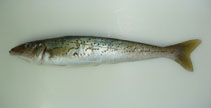
soft rays: 21 - 24. The swim bladder is very elongate with a single slender tapering posterior extension and two anterolateral extensions. No duct-like urogenital aperture is present. Body color is pale brown, gray brown, or dark olive green above, and whitish pale brown or silvery below with reflections of mauve, blue green when fresh. The back and upper sides with oblique rows of small round dark brown to rusty brown spots; the lower sides with open-spaced rather scattered round dark spots. The belly is white and without spots. The dorsal fins are uniformly dark greenish brown to light brown sometimes spotted with dark brown; the anal, pectoral and pelvic fins are pale brown to hyaline; the caudal fin is greenish to brownish and finely dusted with brown (Ref. 6205).
Inhabit shallow inner continental shelf waters, including bays and inlets (Ref. 6390). For their first few years, they live mainly where seagrasses (Zostera species, Posidonia creeks. Small juveniles favor water depths from 2 m to 20 m. Adults inhabit more exposed waters along coastal beaches and reef areas (Ref. 27008, 27667), sometimes to depths as great as 200 m. Spawn in offshore waters from late summer to winter (Ref. 6390). Juveniles feed on benthic amphipods and other crustaceans. As they grow larger, their diet expands to include polychaete worms, mollusks and peanut worms (Sipuncula) (Ref. 27008, 27667). Oviparous (Ref. 205). This premium quality fish obtains a high price (Ref. 6205).
Are serial batch spawners, yet the number of spawnings in a season is unknown (Ref. 6390).
McKay, R.J., 1992. FAO Species Catalogue. Vol. 14. Sillaginid fishes of the world (family Sillaginidae). An annotated and illustrated catalogue of the sillago, smelt or Indo-Pacific whiting species known to date. Rome: FAO. FAO Fish. Synop. 125(14):87p. (Ref. 6205)
IUCN Red List Status (Ref. 130435)
Threat to humans
Harmless
Human uses
Fisheries: commercial; aquaculture: experimental; gamefish: yes
More information
ReferencesAquacultureAquaculture profileStrainsGeneticsElectrophoresesHeritabilityDiseasesProcessingNutrientsMass conversion
Tools
Special reports
Download XML
Internet sources
Estimates based on models
Preferred temperature (Ref.
123201): 15.3 - 18.5, mean 17.4 °C (based on 253 cells).
Phylogenetic diversity index (Ref.
82804): PD
50 = 1.0000 [Uniqueness, from 0.5 = low to 2.0 = high].
Bayesian length-weight: a=0.00501 (0.00258 - 0.00973), b=3.07 (2.90 - 3.24), in cm total length, based on LWR estimates for this species & (Sub)family-body (Ref.
93245).
Trophic level (Ref.
69278): 3.3 ±0.3 se; based on diet studies.
Generation time: 2.3 (1.6 - 6.5) years. Estimated as median ln(3)/K based on 10
growth studies.
Resilience (Ref.
120179): Medium, minimum population doubling time 1.4 - 4.4 years (K=0.47; tm=3-4; tmax=15; Fec=100,000).
Fishing Vulnerability (Ref.
59153): Moderate to high vulnerability (50 of 100).
Nutrients (Ref.
124155): Calcium = 32 [13, 91] mg/100g; Iron = 0.259 [0.098, 0.780] mg/100g; Protein = 20.1 [17.8, 22.2] %; Omega3 = 0.264 [0.123, 0.583] g/100g; Selenium = 28.4 [9.9, 84.1] μg/100g; VitaminA = 7.1 [2.1, 26.7] μg/100g; Zinc = 0.72 [0.34, 1.33] mg/100g (wet weight); based on
nutrient studies.