Elasmobranchii (sharks and rays) >
Carcharhiniformes (Ground sharks) >
Atelomycteridae (Coloured catsharks)
Etymology: Schroederichthys: In honor of American ichthyologist William C. Schroeder (1895-1977), Woods Hole Oceanographic Institution, for his pioneering work (with Henry B. Bigelow) on cartilaginous fishes; ichthyos (Gr.), fish. (See ETYFish); chilensis: -ensis, Latin suffix denoting place: Chile, described from the Pacific of Chile (and Peru). (See ETYFish).
More on author: Guichenot.
Environment: milieu / climate zone / depth range / distribution range
Ecology
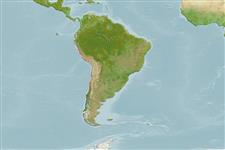
Marine; demersal. Subtropical; 9°S - 51°S
Southeast Pacific: Peru and Chile.
Size / Weight / Age
Maturity: Lm ? range ? - ? cm
Max length : 62.0 cm TL male/unsexed; (Ref. 244)
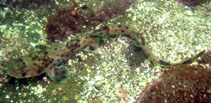
An inshore shark found on the continental shelf. Oviparous (Ref. 50449). Sexual dimorphism is evident in dentition of male species (Ref. 49562).
Life cycle and mating behavior
Maturity | Reproduction | Spawning | Eggs | Fecundity | Larvae
Oviparous, paired eggs are laid. Embryos feed solely on yolk (Ref. 50449). Males have longer teeth with fewer cups than females (Ref. 51093) to make 'courtship biting' more effective (Ref. 49562).
Compagno, L.J.V., 1984. FAO Species Catalogue. Vol. 4. Sharks of the world. An annotated and illustrated catalogue of shark species known to date. Part 2 - Carcharhiniformes. FAO Fish. Synop. 125(4/2):251-655. Rome: FAO. (Ref. 244)
IUCN Red List Status (Ref. 130435)
Threat to humans
Harmless
Human uses
Fisheries: of no interest
More information
Age/SizeGrowthLength-weightLength-lengthLength-frequenciesMorphometricsMorphologyLarvaeLarval dynamicsRecruitmentAbundanceBRUVS
ReferencesAquacultureAquaculture profileStrainsGeneticsElectrophoresesHeritabilityDiseasesProcessingNutrientsMass conversion
Tools
Special reports
Download XML
Internet sources
Estimates based on models
Preferred temperature (Ref.
123201): 10.2 - 13.2, mean 11.3 °C (based on 40 cells).
Phylogenetic diversity index (Ref.
82804): PD
50 = 0.5312 [Uniqueness, from 0.5 = low to 2.0 = high].
Trophic level (Ref.
69278): 3.5 ±0.5 se; based on diet studies.
Resilience (Ref.
120179): Very Low, minimum population doubling time more than 14 years (Fec=2).
Fishing Vulnerability (Ref.
59153): Moderate vulnerability (45 of 100).
Nutrients (Ref.
124155): Calcium = 27.5 [4.5, 149.5] mg/100g; Iron = 0.744 [0.202, 2.283] mg/100g; Protein = 15.9 [13.0, 20.3] %; Omega3 = 0.205 [0.091, 0.441] g/100g; Selenium = 25.5 [7.7, 71.1] μg/100g; VitaminA = 10 [3, 28] μg/100g; Zinc = 0.657 [0.315, 1.206] mg/100g (wet weight);