Teleostei (teleosts) >
Eupercaria/misc (Various families in series Eupercaria) >
Scaridae (Parrotfishes) > Scarinae
Etymology: Scarus: Greek, skaros = a fish described by anciente writers as a parrot fish; 1601 (Ref. 45335).
Environment: milieu / climate zone / depth range / distribution range
Ecology
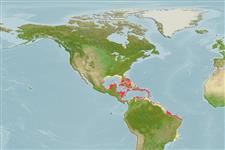
Marine; reef-associated; depth range 2 - 25 m (Ref. 9710). Tropical; 33°N - 34°S, 98°W - 31°W
Western Atlantic: Bermuda, southern Florida (USA), and Bahamas to Brazil; throughout the Caribbean (Ref. 3802).
Length at first maturity / Size / Weight / Age
Maturity: Lm ?, range 17 - ? cm
Max length : 35.0 cm TL male/unsexed; (Ref. 9710); common length : 22.0 cm TL male/unsexed; (Ref. 3802)
Dorsal
spines
(total): 9;
Dorsal
soft rays
(total): 10;
Anal
spines: 3;
Anal
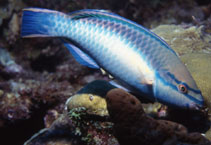
soft rays: 9. Juveniles and young adults dark olive above with 2 broad dark stripes: upper from tip of snout through eye to middle of caudal fin base, lower from chin through pectoral fin base to lower caudal fin base; white area above upper stripe continues around front of head above eye (Ref. 26938).
Found on bottoms with coral or rock (Ref. 13628). Juveniles often occur in association with Thalassia. Forms large feeding aggregations and feeds on plants. Sleeps in a mucus cocoon (Ref. 9710).
Life cycle and mating behavior
Maturity | Reproduction | Spawning | Eggs | Fecundity | Larvae
Oviparous, distinct pairing during breeding (Ref. 205).
Robins, C.R. and G.C. Ray, 1986. A field guide to Atlantic coast fishes of North America. Houghton Mifflin Company, Boston, U.S.A. 354 p. (Ref. 7251)
IUCN Red List Status (Ref. 130435)
Threat to humans
Reports of ciguatera poisoning (Ref. 30303)
Human uses
Fisheries: minor commercial; aquarium: commercial
More information
ReferencesAquacultureAquaculture profileStrainsGeneticsElectrophoresesHeritabilityDiseasesProcessingNutrientsMass conversion
Tools
Special reports
Download XML
Internet sources
Estimates based on models
Preferred temperature (Ref.
123201): 26.2 - 28.2, mean 27.4 °C (based on 664 cells).
Phylogenetic diversity index (Ref.
82804): PD
50 = 0.5000 [Uniqueness, from 0.5 = low to 2.0 = high].
Bayesian length-weight: a=0.01445 (0.00686 - 0.03044), b=3.03 (2.86 - 3.20), in cm total length, based on LWR estimates for this Genus-body shape (Ref.
93245).
Trophic level (Ref.
69278): 2.0 ±0.1 se; based on diet studies.
Resilience (Ref.
120179): High, minimum population doubling time less than 15 months (Preliminary K or Fecundity.).
Fishing Vulnerability (Ref.
59153): Low vulnerability (25 of 100).
Nutrients (Ref.
124155): Calcium = 44.1 [28.9, 73.8] mg/100g; Iron = 0.791 [0.556, 1.203] mg/100g; Protein = 18.6 [16.5, 20.4] %; Omega3 = 0.0898 [, ] g/100g; Selenium = 18.1 [11.3, 28.4] μg/100g; VitaminA = 51 [16, 166] μg/100g; Zinc = 2.33 [1.77, 3.01] mg/100g (wet weight);