Environment: milieu / climate zone / depth range / distribution range
Ecology
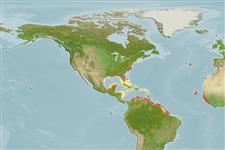
Marine; brackish; benthopelagic; oceanodromous (Ref. 51243); depth range 0 - 22 m (Ref. 26912). Tropical; 46°N - 42°S, 98°W - 33°W
Western Atlantic: from New England (USA) to northern Argentina (Ref. 114953); including northern Florida (USA), throughout the Gulf of Mexico, migrating to Trinidad, Venezuela, Brazil and Uruguay (Ref. 7251).
Length at first maturity / Size / Weight / Age
Maturity: Lm 65.3, range 62 - ? cm
Max length : 120 cm WD male/unsexed; (Ref. 5217); max. published weight: 953.00 g (Ref. 118626)
Short description
Morphology | Morphometrics
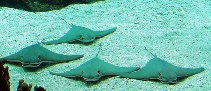
Deep grove around front of head below eyes; forehead above groove indented, snout below groove is distinctly bilobed (Ref. 26938). Disk brown to olive above, with no spots or marks, wings long and pointed (Ref. 7251). Lower surface white or yellowish white (Ref. 6902).
A benthopelagic species found on continental and insular shelves; enters bays and estuaries; forms huge schools inshore (Ref. 114953). Feeds mainly on benthic invertebrates and molluscs (implicated in damaging seagrass beds) (Ref. 93252, 114953). Jumps occasionally, landing with a loud smack, probably as a territorial display. Migrates south in large schools that disappear off northern Florida, USA and are not reported from Caribbean Is.; tagged fish have been recovered in northern South America (Ref. 7251). Population in the Gulf of Mexico migrates clockwise; schools of up to 10,000 rays leave west coast of Florida for Yucatan, Mexico in the fall (Ref. 7251). Ovoviviparous (Ref. 50449).
Life cycle and mating behavior
Maturity | Reproduction | Spawning | Eggs | Fecundity | Larvae
Exhibit ovoviparity (aplacental viviparity), with embryos feeding initially on yolk, then receiving additional nourishment from the mother by indirect absorption of uterine fluid enriched with mucus, fat or protein through specialised structures (Ref. 50449).
Last, P.R., W.T. White, M.R. de Carvalho, B. Séret, M.F.W. Stehmann and G.J.P. Naylor, 2016. Rays of the world. CSIRO Publishing, Comstock Publishing Associates. i-ix + 1-790. (Ref. 114953)
IUCN Red List Status (Ref. 130435)
Threat to humans
Traumatogenic (Ref. 4690)
Human uses
Fisheries: minor commercial; aquarium: public aquariums
More information
ReferencesAquacultureAquaculture profileStrainsGeneticsElectrophoresesHeritabilityDiseasesProcessingNutrientsMass conversion
Tools
Special reports
Download XML
Internet sources
Estimates based on models
Preferred temperature (Ref.
123201): 20 - 28.1, mean 26.7 °C (based on 643 cells).
Phylogenetic diversity index (Ref.
82804): PD
50 = 0.5039 [Uniqueness, from 0.5 = low to 2.0 = high].
Bayesian length-weight: a=0.01202 (0.00693 - 0.02085), b=2.98 (2.82 - 3.14), in cm total length, based on LWR estimates for this species & (Sub)family-body (Ref.
93245).
Trophic level (Ref.
69278): 3.2 ±0.0 se; based on diet studies.
Resilience (Ref.
120179): Low, minimum population doubling time 4.5 - 14 years (Fec assumed to be <100).
Fishing Vulnerability (Ref.
59153): High vulnerability (59 of 100).