Teleostei (teleosts) >
Characiformes (Characins) >
Serrasalmidae (Piranhas and pacus) > Serrasalminae
Etymology: Pygocentrus: Greek, pyge = rump + Greek, kentron = sting (Ref. 45335).
More on author: Kner.
Environment: milieu / climate zone / depth range / distribution range
Ecology
Freshwater; pelagic; pH range: 5.5 - 7.5; dH range: ? - 20. Subtropical; 23°C - 27°C (Ref. 13371); 9°N - 34°S
South America: Amazon River basin, Paraguay-Paraná River basin, northeastern Brazilian coastal rivers and Essequibo River basin (Ref. 39031). Reported from the Uruguay River, Brazil (Ref. 79585).
Length at first maturity / Size / Weight / Age
Maturity: Lm ? range ? - 15 cm
Max length : 50.0 cm SL male/unsexed; (Ref. 81048); max. published weight: 3.9 kg (Ref. 40637)
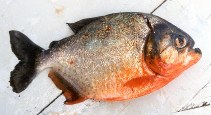
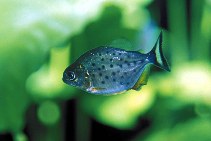
Common in creeks and interconnected ponds in Matto Grosso, Brazil, where it influences distribution and feeding of other fish (Ref. 9080) and in areas of high primary production in Rio Machado and Rio Negro (Ref.9096). Adults feed mainly at dusk and dawn. Feeds on insects, worms and fish (Ref. 7020). Medium-sized to large individuals (15-24 cm length) forage mainly at dawn, late afternoon and night up to about 2200H, whereas smaller fish (8-11 cm) are active mainly during the day (Ref. 9080). Teeth replacement on alternating sides of jaw allows continuous feeding. Its powerful dentition can inflict serious bites. Has a highly evolved auditory capacity and a 'lurking', then 'dashing' behavior during daytime. Shows hierarchies within small schools (Ref. 9077). Available information on body composition of 'piranha caju' flesh is 8.2% fat, 15.0% protein and 4.4% ash (Ref. 9251).
Males and females appear externally alike (Refs. 2279 & 9245). In 'Serrasalmus sp. aff. nattereri', reported to occur in the Orinoco basin (Venezuela, Guyana), the males have more 'bull-like' heads, but are more slender than females (Ref. 1672). Eggs are laid on tree roots trailing in the water and are guarded; the reproductive success may vary strongly from year to year depending on how the savanna was flooded (Ref. 9078). The eggs are large, adhere to plants and are not attacked by the parents. They hatch in 9 to10 days (Ref. 7020).
Fink, W.L., 1993. Revision of the piranha genus Pygocentrus. Copeia 1993(3):665-687. (Ref. 27142)
IUCN Red List Status (Ref. 130435)
Threat to humans
Traumatogenic (Ref. 4537)
Human uses
Fisheries: minor commercial; aquarium: commercial
Tools
Special reports
Download XML
Internet sources
Estimates based on models
Phylogenetic diversity index (Ref.
82804): PD
50 = 0.5625 [Uniqueness, from 0.5 = low to 2.0 = high].
Bayesian length-weight: a=0.02089 (0.01373 - 0.03180), b=3.16 (3.04 - 3.28), in cm total length, based on LWR estimates for this species & (Sub)family-body (Ref.
93245).
Trophic level (Ref.
69278): 3.7 ±0.61 se; based on food items.
Generation time: 1.7 ( na - na) years. Estimated as median ln(3)/K based on 1
growth studies.
Resilience (Ref.
120179): Medium, minimum population doubling time 1.4 - 4.4 years (K=0.89; tm=1; Fec=4,000-5,000).
Fishing Vulnerability (Ref.
59153): Moderate vulnerability (44 of 100).
Nutrients (Ref.
124155): Calcium = 59.4 [26.7, 161.3] mg/100g; Iron = 2.16 [1.01, 5.44] mg/100g; Protein = 19.6 [17.4, 22.0] %; Omega3 = 0.665 [0.258, 1.848] g/100g; Selenium = 32.6 [11.5, 81.7] μg/100g; VitaminA = 14.8 [3.9, 59.4] μg/100g; Zinc = 0.783 [0.500, 1.228] mg/100g (wet weight);