Teleostei (teleosts) >
Cypriniformes (Carps) >
Cyprinidae (Minnows or carps) > Smiliogastrinae
Etymology: Prolabeo: Greek, pro = first, in front of + Latin, labeo = who has larger lips (Ref. 45335).
More on author: Norman.
Environment: milieu / climate zone / depth range / distribution range
Ecology
Freshwater; demersal. Tropical
Africa: known from Sierra Leone in the Sewa, Rokel, Pampana (Ref. 2940, 13331, 81282) and Little Scarcies rivers (Ref. 13331).
Size / Weight / Age
Maturity: Lm ? range ? - ? cm
Max length : 10.5 cm TL male/unsexed; (Ref. 2801)
Short description
Morphology | Morphometrics
Dorsal
soft rays
(total): 11;
Anal
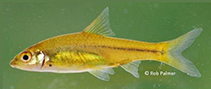
soft rays: 8. Diagnosis: scales with reduced number parallel to slightly divergent striae; small inferior mouth, lower lip covered by thin layer of `horn'; transverse, more or less deeply notched, lobe in front of mouth covering upper lip; two pairs of short barbels; dorsal fin without ossified ray but with 8 branched rays; last of simple dorsal rays about as long as head (Ref. 2940, 81282).
Affinities: B. wurtzi (no Labeo-type month). Monospecific genus.
Life cycle and mating behavior
Maturity | Reproduction | Spawning | Eggs | Fecundity | Larvae
Lévêque, C., 1990. Cyprinidae. p. 269-361. In C. Lévêque, D. Paugy and G.G. Teugels (eds.) Faune des poissons d'eaux douces et saumâtres d'Afrique de l'Ouest. Tome I. Coll. Faune Tropicale n° XXVIII. Musée Royal de l'Afrique Centrale, Tervuren, and O.R.S.T.O.M., Paris, 384 p. (Ref. 2940)
IUCN Red List Status (Ref. 130435)
Threat to humans
Harmless
Human uses
More information
Common namesSynonymsMetabolismPredatorsEcotoxicologyReproductionMaturitySpawningSpawning aggregationFecundityEggsEgg development
Age/SizeGrowthLength-weightLength-lengthLength-frequenciesMorphometricsMorphologyLarvaeLarval dynamicsRecruitmentAbundanceBRUVS
ReferencesAquacultureAquaculture profileStrainsGeneticsElectrophoresesHeritabilityDiseasesProcessingNutrientsMass conversion
Tools
Special reports
Download XML
Internet sources
Estimates based on models
Phylogenetic diversity index (Ref.
82804): PD
50 = 1.0000 [Uniqueness, from 0.5 = low to 2.0 = high].
Bayesian length-weight: a=0.01096 (0.00516 - 0.02330), b=2.99 (2.82 - 3.16), in cm total length, based on LWR estimates for this (Sub)family-body shape (Ref.
93245).
Trophic level (Ref.
69278): 2.9 ±0.3 se; based on size and trophs of closest relatives
Resilience (Ref.
120179): High, minimum population doubling time less than 15 months (Preliminary K or Fecundity.).
Fishing Vulnerability (Ref.
59153): Low vulnerability (10 of 100).