Teleostei (teleosts) >
Eupercaria/misc (Various families in series Eupercaria) >
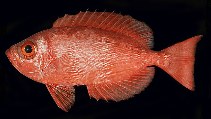
Priacanthidae (Bigeyes or catalufas)
Etymology: Priacanthus: Greek, prion = saw + Greek, akantha = thorn (Ref. 45335).
Environment: milieu / climate zone / depth range / distribution range
Ecology
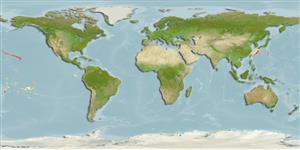
Marine; reef-associated; non-migratory; depth range 3 - 230 m (Ref. 38732). Tropical
Eastern Pacific: Hawaiian and Midway Islands; a single juvenile specimen recorded from the Galapagos Islands. Strays reach Johnston Atoll (Ref. 9710). Reports from Japan are probably misidentifications of Priacanthus hamrur.
Size / Weight / Age
Maturity: Lm ? range ? - ? cm
Max length : 33.0 cm TL male/unsexed; (Ref. 9710)
Inhabit clear lagoon and seaward reefs. Found under ledges during the day (Ref. 9710). Benthopelagic (Ref. 58302). Spawning may occur by December or soon after. Sound production has been studied in this species (Ref. 5403).
Life cycle and mating behavior
Maturity | Reproduction | Spawning | Eggs | Fecundity | Larvae
Starnes, W.C., 1988. Revision, phylogeny and biogeographic comments on the circumtropical marine percoid fish family Priacanthidae. Bull. Mar. Sci. 43(2):117-203. (Ref. 5403)
IUCN Red List Status (Ref. 130435)
Threat to humans
Harmless
Human uses
Fisheries: subsistence fisheries; aquarium: commercial
More information
Common namesSynonymsMetabolismPredatorsEcotoxicologyReproductionMaturitySpawningSpawning aggregationFecundityEggsEgg development
Age/SizeGrowthLength-weightLength-lengthLength-frequenciesMorphometricsMorphologyLarvaeLarval dynamicsRecruitmentAbundanceBRUVS
ReferencesAquacultureAquaculture profileStrainsGeneticsElectrophoresesHeritabilityDiseasesProcessingNutrientsMass conversion
Tools
Special reports
Download XML
Internet sources
Estimates based on models
Preferred temperature (Ref.
123201): 18.7 - 23.1, mean 20.8 °C (based on 10 cells).
Phylogenetic diversity index (Ref.
82804): PD
50 = 0.5002 [Uniqueness, from 0.5 = low to 2.0 = high].
Bayesian length-weight: a=0.01698 (0.00740 - 0.03896), b=2.91 (2.72 - 3.10), in cm total length, based on LWR estimates for this (Sub)family-body shape (Ref.
93245).
Trophic level (Ref.
69278): 4.2 ±0.73 se; based on food items.
Resilience (Ref.
120179): High, minimum population doubling time less than 15 months (Preliminary K or Fecundity.).
Fishing Vulnerability (Ref.
59153): Low vulnerability (23 of 100).
Nutrients (Ref.
124155): Calcium = 53.3 [34.5, 83.5] mg/100g; Iron = 0.729 [0.464, 1.097] mg/100g; Protein = 19.3 [18.2, 20.2] %; Omega3 = 0.185 [0.121, 0.280] g/100g; Selenium = 43.7 [26.0, 76.3] μg/100g; VitaminA = 105 [45, 255] μg/100g; Zinc = 0.942 [0.676, 1.292] mg/100g (wet weight);