Environment: milieu / climate zone / depth range / distribution range
Ecology
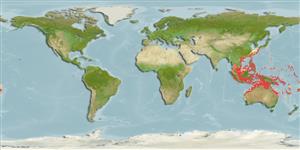
Marine; reef-associated; depth range 3 - 100 m (Ref. 9710). Tropical; 24°C - ? (Ref. 2160); 35°N - 30°S, 99°E - 178°W (Ref. 5222)
Western Pacific: from Western Australia, eastward to the Caroline Islands and Fiji: from southern Japan to Australia (Queensland); also recently recorded from Tonga (Ref. 53797). Often misidentified as Plectropomus maculatus.
Length at first maturity / Size / Weight / Age
Maturity: Lm 37.3, range 21 - 60 cm
Max length : 120 cm SL male/unsexed; (Ref. 6390); common length : 35.0 cm SL male/unsexed; (Ref. ); max. published weight: 23.6 kg (Ref. 6390); max. reported age: 26 years (Ref. 3639)
Dorsal
spines
(total): 7 - 8;
Dorsal
soft rays
(total): 10-12;
Anal
spines: 3;
Anal
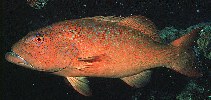
soft rays: 8. This species is distinguished by the following characters: D VIII,11; A III,8; pectoral rays 14-17 (modally 16); lateral line scales 89-99, in longitudinal series 112-127 scales; interorbital space no embedded scales; gill rakers on first gill arch developed 1-3 + 6-10; front of jaws with a pair of large canine teeth and side of lower jaw with 1-4 large canines; body elongate, its greatest depth 2.9-3.6 in SL; truncate to slightly emarginate caudal fin; pectoral fins 2.0-2.3 in HL; pelvic fins 2.0-2.4 in HL; Head, body and fins with numerous blue spots on red, pale grey or olive to dark brown background; caudal fin with a narrow white posterior margin except near the corners; juveniles (< 5 cm) brown on upper 2/3 of side with scattered blue spots, broad whitish stripe from eye to caudal fin base, white on lower head and yellowish ventrally on side (Ref. 4787, 54980, 90102).
Inhabit coral-rich areas of lagoon reefs and mid-shelf reefs (Ref. 6390, 48635). Solitary (Ref. 90102). Inactive at night, hiding under ledges (Ref. 9710). Juveniles have a demersal existence in shallow water in reef habitats, especially around coral rubble (Ref. 27259). Adults feed mainly on fish (Ref. 6390), juveniles feed on small fish and invertebrates such as crustaceans and squid (Ref. 27261). A protogynous hermaphrodite (Ref. 55367). Form several spawning aggregations on a reef occurring around the new moon (Ref. 27259). Eggs float just below the surface (Ref. 6390). Larvae are pelagic (Ref. 6390). P. leopardus is used in cage culture; P. maculatus in Ref. 3081 was probably a mixture of P. maculatus and P. leopardus; the Plectropomus sp. used for the experiments reported in Capra et al., 1988 (Ref. 4719) consisted predominantly of P. leopardus, with some P. maculatus (M.F. Capra, pers. comm.). On the Great Barrier Reef, its maximum lifespan is 14 years (Ref. 37816).
A monandric species (Ref. 55367) but now confirmed for diandry (Ref. 103751). Estimated size at sex change occurs at 32.1 cm TL and 16 years of age (Ref. 55367).
Courtship behavior: a male approaches 1 or more females from behind, changing color from dark brown to brownish white while the edges of median fins remained dark. As the male gets near, it flicks its dorsal and pelvic fins eliciting a mild lateral display from the female. The male rolls onto its side and shakes from side to side as its abdomen passes the female. Takes 15 seconds (Ref. 2160).
Heemstra, P.C. and J.E. Randall, 1993. FAO Species Catalogue. Vol. 16. Groupers of the world (family Serranidae, subfamily Epinephelinae). An annotated and illustrated catalogue of the grouper, rockcod, hind, coral grouper and lyretail species known to date. Rome: FAO. FAO Fish. Synop. 125(16):382 p. (Ref. 5222)
IUCN Red List Status (Ref. 130435)
Threat to humans
Reports of ciguatera poisoning (Ref. 4821)
Human uses
Fisheries: commercial; aquaculture: commercial; gamefish: yes; aquarium: commercial
Tools
Special reports
Download XML
Internet sources
Estimates based on models
Preferred temperature (Ref.
123201): 24.7 - 29, mean 28 °C (based on 1194 cells).
Phylogenetic diversity index (Ref.
82804): PD
50 = 0.5078 [Uniqueness, from 0.5 = low to 2.0 = high].
Bayesian length-weight: a=0.01202 (0.01079 - 0.01339), b=3.04 (3.01 - 3.07), in cm total length, based on LWR estimates for this species (Ref.
93245).
Trophic level (Ref.
69278): 4.4 ±0.7 se; based on diet studies.
Resilience (Ref.
120179): Medium, minimum population doubling time 1.4 - 4.4 years (tm=2-4; tmax=26; Fec=457,900).
Prior r = 0.71, 95% CL = 0.47 - 1.06, Based on 1 stock assessment.
Fishing Vulnerability (Ref.
59153): Moderate to high vulnerability (55 of 100).
Climate Vulnerability (Ref.
125649): Very high vulnerability (85 of 100).
Nutrients (Ref.
124155): Calcium = 20.9 [13.0, 35.5] mg/100g; Iron = 0.476 [0.259, 0.771] mg/100g; Protein = 18.9 [17.0, 20.5] %; Omega3 = 0.139 [0.092, 0.216] g/100g; Selenium = 46.2 [27.6, 81.8] μg/100g; VitaminA = 81.1 [30.8, 253.1] μg/100g; Zinc = 0.663 [0.464, 0.945] mg/100g (wet weight);