Teleostei (teleosts) >
Siluriformes (Catfishes) >
Sisoridae (Sisorid catfishes) > Glyptosterninae
Etymology: Parachiloglanis: Greek, para = the side of + Greek, cheilos = lip + Greek, glanis = a fish that can eat the bait without touching the hook; a cat fish (Ref. 45335).
More on author: Hora.
Environment: milieu / climate zone / depth range / distribution range
Ecology
Freshwater; demersal. Tropical
Asia: India and Bangladesh. Reported from Nepal (Ref. 12045) and Tibet (Ref. 32617).
Size / Weight / Age
Maturity: Lm ? range ? - ? cm
Max length : 6.6 cm SL male/unsexed; (Ref. 97387)
Short description
Morphology | Morphometrics
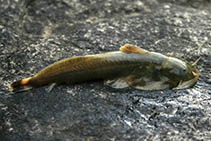
Parachiloglanis hodgarti is distinguished from its only congener P. bhutanensis by having lateral-line pores greatly reduced or absent (vs. 35-40 large lateral-line pores running the length of the body from the posterior edge of the head to the caudal base), shorter adipose fin height 2.2-4.3% SL (vs. 4.2-4.6% SL, large fleshy adipose fin), shallower head depth 36-45% HL (vs. 47-59% HL), shorter inner- and outer-mandibular barbels (5.2-11.0% HL vs. 11.0-16.5% HL, and 14.2-23.6% HL vs. 23.9-31.8% HL, respectively), indented to lunate caudal fin (vs. truncate), and presence of black and white markings on caudal fin (vs. absence) (Ref. 97387).
Inhabits torrential streams (Ref. 4833). Occurs in mountain rapids (Ref. 41236).
Life cycle and mating behavior
Maturity | Reproduction | Spawning | Eggs | Fecundity | Larvae
He, S., 1996. The phylogeny of the glyptosternoid fishes (Teleostei: Siluriformes, Sisoridae). Cybium 20(2):115-159. (Ref. 27962)
IUCN Red List Status (Ref. 130435)
Threat to humans
Harmless
Human uses
Fisheries: of no interest
More information
Common namesSynonymsMetabolismPredatorsEcotoxicologyReproductionMaturitySpawningSpawning aggregationFecundityEggsEgg development
Age/SizeGrowthLength-weightLength-lengthLength-frequenciesMorphometricsMorphologyLarvaeLarval dynamicsRecruitmentAbundanceBRUVS
ReferencesAquacultureAquaculture profileStrainsGeneticsElectrophoresesHeritabilityDiseasesProcessingNutrientsMass conversion
Tools
Special reports
Download XML
Internet sources
Estimates based on models
Phylogenetic diversity index (Ref.
82804): PD
50 = 0.7500 [Uniqueness, from 0.5 = low to 2.0 = high].
Bayesian length-weight: a=0.00589 (0.00260 - 0.01333), b=3.08 (2.88 - 3.28), in cm total length, based on LWR estimates for this (Sub)family-body shape (Ref.
93245).
Trophic level (Ref.
69278): 3.1 ±0.4 se; based on size and trophs of closest relatives
Fishing Vulnerability (Ref.
59153): Low vulnerability (10 of 100).