Teleostei (teleosts) >
Clupeiformes (Herrings) >
Dorosomatidae (Gizzard shads and sardinellas)
Etymology: Opisthonema: Greek, opisthe = behind + Greek,nema = filament (Ref. 45335).
Environment: milieu / climate zone / depth range / distribution range
Ecology
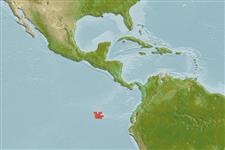
Marine; pelagic-neritic; depth range 0 - 50 m (Ref. 188). Tropical; 3°N - 4°S, 94°W - 89°W (Ref. 188)
Southeast Pacific: endemic to the Galapagos Islands.
Size / Weight / Age
Maturity: Lm ? range ? - ? cm
Max length : 26.0 cm SL male/unsexed; (Ref. 188); common length : 18.0 cm SL male/unsexed; (Ref. 188)
Dorsal
spines
(total): 0;
Dorsal
soft rays
(total): 13-21;
Anal
spines: 0;
Anal
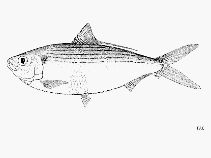
soft rays: 15 - 17. The filamentous last dorsal fin ray distinguishes this species from members of any other eastern Pacific clupeoid genus. Lower gill rakers 50 to 87 in fishes over 14 cm standard length (intermediate between O. medirastre with 41 to 69 and O. libertate with 63 to 110, but neither of these occur in the Galapagos Islands).
Forms schools.
Life cycle and mating behavior
Maturity | Reproduction | Spawning | Eggs | Fecundity | Larvae
Whitehead, P.J.P., 1985. FAO Species Catalogue. Vol. 7. Clupeoid fishes of the world (suborder Clupeoidei). An annotated and illustrated catalogue of the herrings, sardines, pilchards, sprats, shads, anchovies and wolf-herrings. FAO Fish. Synop. 125(7/1):1-303. Rome: FAO. (Ref. 188)
IUCN Red List Status (Ref. 130435)
Threat to humans
Harmless
Human uses
Fisheries: subsistence fisheries
More information
Common namesSynonymsMetabolismPredatorsEcotoxicologyReproductionMaturitySpawningSpawning aggregationFecundityEggsEgg development
ReferencesAquacultureAquaculture profileStrainsGeneticsElectrophoresesHeritabilityDiseasesProcessingNutrientsMass conversion
Tools
Special reports
Download XML
Internet sources
Estimates based on models
Preferred temperature (Ref.
123201): 14.5 - 23.7, mean 19.3 °C (based on 4 cells).
Phylogenetic diversity index (Ref.
82804): PD
50 = 0.5312 [Uniqueness, from 0.5 = low to 2.0 = high].
Bayesian length-weight: a=0.00912 (0.00433 - 0.01920), b=3.04 (2.87 - 3.21), in cm total length, based on LWR estimates for this (Sub)family-body shape (Ref.
93245).
Trophic level (Ref.
69278): 3.3 ±0.4 se; based on size and trophs of closest relatives
Resilience (Ref.
120179): High, minimum population doubling time less than 15 months (Preliminary K or Fecundity.).
Fishing Vulnerability (Ref.
59153): Low vulnerability (22 of 100).
Nutrients (Ref.
124155): Calcium = 175 [97, 371] mg/100g; Iron = 1.71 [0.94, 3.00] mg/100g; Protein = 19.2 [18.0, 20.4] %; Omega3 = 0.442 [0.231, 0.860] g/100g; Selenium = 36.6 [17.6, 89.3] μg/100g; VitaminA = 43.8 [14.7, 136.6] μg/100g; Zinc = 1.05 [0.70, 1.62] mg/100g (wet weight);