Teleostei (teleosts) >
Scombriformes (Mackerels) >
Nomeidae (Driftfishes)
Etymology: Nomeus: Greek, nomeys, -eos = shepherd (Ref. 45335).
More on author: Gmelin.
Environment: milieu / climate zone / depth range / distribution range
Ecology
Marine; demersal; depth range 200 - 1000 m (Ref. 58302). Subtropical; 52°N - 45°S
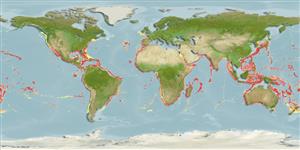
Western Atlantic: Newfoundland, Canada and northern Gulf of Mexico to Brazil (Ref. 7251). Eastern Atlantic: north-west Africa and the Canary Islands (Ref. 4777); also São Tomé Island (Ref. 34088). Not recorded from the Mediterranean and most of the eastern Atlantic (Ref. 9834). Indian and Pacific: widely distributed.
Size / Weight / Age
Maturity: Lm ? range ? - ? cm
Max length : 39.0 cm TL male/unsexed; (Ref. 4412)
Dorsal
spines
(total): 9 - 13;
Dorsal
soft rays
(total): 24-28;
Anal
spines: 1-2;
Anal
soft rays: 24 - 29;
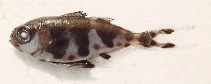
Vertebrae: 41. Juveniles whitish or silvery with dark blue mottlings; pelvic fins black (Ref. 4412). Dark blue above, side silvery with patches of dark blue. Pelvic fin with inner rays joined to abdomen by membrane for its entire length (Ref. 26938).
Found offshore in warm waters. Juveniles pelagic in coastal and offshore waters down to at least 30 m, but adults possibly demersal in deep water (Ref. 9563). Occur in association with floating Portuguese man-of-war, Physalia, feeding on its tentacles and gonads and may drift with it into shore waters with proper wind conditions (Ref. 4777). Probably also feed on other soft-bodied jellyfish as well as on zooplankton (Ref.4777).
Life cycle and mating behavior
Maturity | Reproduction | Spawning | Eggs | Fecundity | Larvae
Haedrich, R.L., 1986. Nomeidae. p. 1183-1188. In P.J.P. Whitehead, M.-L. Bauchot, J.-C. Hureau, J. Nielsen and E. Tortonese (eds.) Fishes of the North-eastern Atlantic and the Mediterranean. UNESCO, Paris. Vol. 3. (Ref. 4777)
IUCN Red List Status (Ref. 130435)
Threat to humans
Harmless
Human uses
Fisheries: minor commercial
More information
ReferencesAquacultureAquaculture profileStrainsGeneticsElectrophoresesHeritabilityDiseasesProcessingNutrientsMass conversion
Tools
Special reports
Download XML
Internet sources
Estimates based on models
Preferred temperature (Ref.
123201): 7.7 - 15.4, mean 10.4 °C (based on 658 cells).
Phylogenetic diversity index (Ref.
82804): PD
50 = 1.0000 [Uniqueness, from 0.5 = low to 2.0 = high].
Bayesian length-weight: a=0.00977 (0.00420 - 0.02273), b=3.09 (2.88 - 3.30), in cm total length, based on LWR estimates for this (Sub)family-body shape (Ref.
93245).
Trophic level (Ref.
69278): 3.7 ±0.38 se; based on food items.
Resilience (Ref.
120179): High, minimum population doubling time less than 15 months (Preliminary K or Fecundity.).
Fishing Vulnerability (Ref.
59153): Low to moderate vulnerability (29 of 100).