Environment: milieu / climate zone / depth range / distribution range
Ecology
Marine; reef-associated; depth range 8 - 30 m (Ref. 90102), usually 15 - 20 m (Ref. 48637). Tropical; 25°C - 28°C (Ref. 27115); 33°N - 25°S
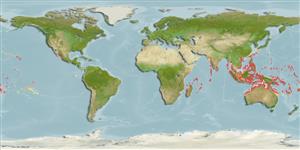
Indo-Pacific: East Africa to the Marquesan and Society islands, north to the Ryukyu Islands, south to Vanuatu.
Size / Weight / Age
Maturity: Lm ? range ? - ? cm
Max length : 90.0 cm FL male/unsexed; (Ref. 1602)
Dorsal
spines
(total): 4 - 5;
Dorsal
soft rays
(total): 28-30;
Anal
spines: 2;
Anal
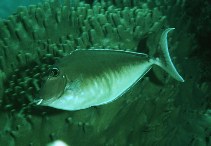
soft rays: 27 - 28. Distinctive humped back; horn only in adult males. A few scattered small dark-edged pale spots on postorbital head and body above pectoral fins. No white margin posteriorly on caudal fin. Profile of snout from mouth to eye strongly sloping, forming an angle of about 40° to horizontal axis of body (Ref 9808).
Inhabits deep coastal, usually in small groups but occasionally in large schools (Ref. 48637). Sometimes solitary (Ref. 90102). An uncommon species found in seaward reef slopes (Ref. 9710, 48637), also along rocky shores (Ref. 30573). Feeds on benthic algae (Ref. 30573). Caught with nets (Ref. 30573).
Life cycle and mating behavior
Maturity | Reproduction | Spawning | Eggs | Fecundity | Larvae
Spawn in pairs (Ref. 240).
Myers, R.F., 1991. Micronesian reef fishes. Second Ed. Coral Graphics, Barrigada, Guam. 298 p. (Ref. 1602)
IUCN Red List Status (Ref. 130435)
Threat to humans
Harmless
Human uses
Aquarium: commercial
More information
ReferencesAquacultureAquaculture profileStrainsGeneticsElectrophoresesHeritabilityDiseasesProcessingNutrientsMass conversion
Tools
Special reports
Download XML
Internet sources
Estimates based on models
Preferred temperature (Ref.
123201): 25.7 - 29, mean 28.1 °C (based on 218 cells).
Phylogenetic diversity index (Ref.
82804): PD
50 = 0.5000 [Uniqueness, from 0.5 = low to 2.0 = high].
Bayesian length-weight: a=0.01995 (0.00906 - 0.04395), b=3.00 (2.82 - 3.18), in cm total length, based on LWR estimates for this Genus-body shape (Ref.
93245).
Trophic level (Ref.
69278): 2.7 ±0.29 se; based on food items.
Resilience (Ref.
120179): Low, minimum population doubling time 4.5 - 14 years (K=0.429; tmax=31).
Fishing Vulnerability (Ref.
59153): High vulnerability (60 of 100).
Nutrients (Ref.
124155): Calcium = 23.1 [13.7, 44.2] mg/100g; Iron = 0.437 [0.219, 0.804] mg/100g; Protein = 18.8 [17.7, 19.9] %; Omega3 = 0.107 [0.065, 0.200] g/100g; Selenium = 36.5 [18.1, 64.6] μg/100g; VitaminA = 54.9 [16.4, 168.2] μg/100g; Zinc = 1.26 [0.87, 1.79] mg/100g (wet weight);