Environment: milieu / climate zone / depth range / distribution range
Ecology
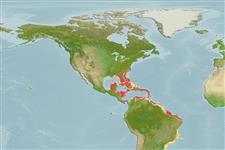
Marine; reef-associated; depth range 2 - 137 m (Ref. 5222), usually 5 - 35 m (Ref. 40849). Subtropical; 35°N - 28°S, 92°W - 33°W (Ref. 5222)
Western Atlantic: Bermuda, Gulf of Mexico and the Caribbean south to Sao Paulo, Brazil.
Length at first maturity / Size / Weight / Age
Maturity: Lm 53.6, range 50 - 63 cm
Max length : 100.0 cm TL male/unsexed; (Ref. 26340); common length : 50.0 cm TL male/unsexed; (Ref. 5217); max. published weight: 18.5 kg (Ref. 40637)
Dorsal
spines
(total): 11;
Dorsal
soft rays
(total): 15-16;
Anal
spines: 3;
Anal
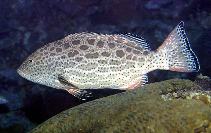
soft rays: 10 - 12. Distinguished by the following characteristics: Head and body have oval groups of dark spots; outer third of pectoral fin bright yellow (Ref. 26938); two color morphs: a deep-water reddish form and shallow-water greenish form; depth of body contained 2.9-3.2 times in SL; head length 2.6-2.9 times in SL; convex interorbital area; evenly rounded preopercle or with slight notch, without projecting bony lobe at the angle; nostrils subequal or posterior nostrils with diameter twice the size of anterior nostrils (Ref. 89707).
Adults found on rocky and coral reefs, juveniles occur in shallow turtle grass beds. Also been taken in trawls over mud bottom in the northern Gulf of Mexico. Feeds mainly on fishes (mostly on coral reef species) and squids. Although often implicated in ciguatera poisonings, it is a desirable food fish; and even large (5 to 10 kg) fish from areas considered safe are sold in markets. Also caught with surface trolling. Sex-reversal has been observed (Ref. 5521).
Heemstra, P.C. and J.E. Randall, 1993. FAO Species Catalogue. Vol. 16. Groupers of the world (family Serranidae, subfamily Epinephelinae). An annotated and illustrated catalogue of the grouper, rockcod, hind, coral grouper and lyretail species known to date. Rome: FAO. FAO Fish. Synop. 125(16):382 p. (Ref. 5222)
IUCN Red List Status (Ref. 130435)
Threat to humans
Reports of ciguatera poisoning (Ref. 4690)
Human uses
Fisheries: highly commercial; gamefish: yes; aquarium: public aquariums
More information
ReferencesAquacultureAquaculture profileStrainsGeneticsElectrophoresesHeritabilityDiseasesProcessingNutrientsMass conversion
Tools
Special reports
Download XML
Internet sources
Estimates based on models
Preferred temperature (Ref.
123201): 24.3 - 28, mean 27 °C (based on 310 cells).
Phylogenetic diversity index (Ref.
82804): PD
50 = 0.5000 [Uniqueness, from 0.5 = low to 2.0 = high].
Bayesian length-weight: a=0.01122 (0.00720 - 0.01748), b=3.04 (2.92 - 3.16), in cm total length, based on LWR estimates for this species & Genus-body shape (Ref.
93245).
Trophic level (Ref.
69278): 4.5 ±0.5 se; based on diet studies.
Resilience (Ref.
120179): Low, minimum population doubling time 4.5 - 14 years (K=0.09-0.17; tmax=15; Fec=400,000).
Fishing Vulnerability (Ref.
59153): High vulnerability (62 of 100).
Climate Vulnerability (Ref.
125649): Very high vulnerability (86 of 100).
Nutrients (Ref.
124155): Calcium = 12.5 [7.1, 26.2] mg/100g; Iron = 0.452 [0.227, 0.786] mg/100g; Protein = 19.4 [17.5, 21.0] %; Omega3 = 0.219 [0.129, 0.378] g/100g; Selenium = 21.5 [10.5, 42.7] μg/100g; VitaminA = 70.2 [22.5, 249.8] μg/100g; Zinc = 0.489 [0.322, 0.741] mg/100g (wet weight);