Elasmobranchii (sharks and rays) >
Carcharhiniformes (Ground sharks) >
Triakidae (Houndsharks) > Triakinae
Etymology: Mustelus: Latin for weasel, an ancient name for sharks, possibly referring to the pointed snouts, swift movements and/or rapacious feeding behavior of smaller predatory sharks [strictly not tautonymous with Squalus mustelus Linnaeus 1758 since type was designated by the ICZN]. (See ETYFish); mustelus: Latin for weasel, an ancient name for sharks, possibly referring to the pointed snouts, swift movements and/or rapacious feeding behavior of smaller predatory sharks. (See ETYFish).
More on author: Linnaeus.
Environment: milieu / climate zone / depth range / distribution range
Ecology
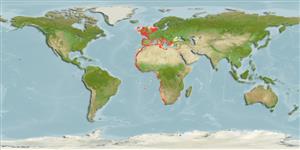
Marine; demersal; depth range 5 - 624 m (Ref. 56504), usually 5 - 50 m (Ref. 244). Temperate; 58°N - 34°S, 19°W - 36°E
Eastern Atlantic: from the UK in the northeast Atlantic, south, including the Mediterranean Sea, Canary Islands, Morocco and south along the western African coast to eastern South Africa (Ref. 244, 127434). Often referred to as Mustelus canis which is restricted to the western Atlantic.
Length at first maturity / Size / Weight / Age
Maturity: Lm ?, range 80 - ? cm
Max length : 200 cm TL male/unsexed; (Ref. 27000); common length : 100.0 cm TL male/unsexed; (Ref. 26999); max. reported age: 24 years (Ref. 30745)
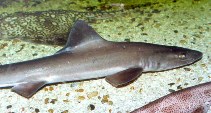
Found on the continental shelves and uppermost slopes, from the intertidal region to at least 350 m depth (Ref. 244). Collected to depth of 624 m in the eastern Ionian Sea (Ref. 56504). Sometimes in midwater but prefers to swim near the bottom (Ref. 244). Feeds mainly on crustaceans, but also cephalopods and bony fishes (Ref. 244). Viviparous, with a yolk-sac placenta (Ref. 244). Taken by shore and ski-boat anglers (Ref. 5578). Utilized for human consumption, oil, and fishmeal (Ref. 244). Sexual maturity is reached at a length of 70-80 cm (Ref. 35388).
Viviparous, with a yolk-sac placenta; 4 to 17 (Ref. 39938) young in a litter. Size at birth about 39 cm. Distinct pairing with embrace (Ref. 205).
Compagno, L.J.V., 1984. FAO Species Catalogue. Vol. 4. Sharks of the world. An annotated and illustrated catalogue of shark species known to date. Part 2 - Carcharhiniformes. FAO Fish. Synop. 125(4/2):251-655. Rome: FAO. (Ref. 244)
IUCN Red List Status (Ref. 130435)
Threat to humans
Harmless
Human uses
Fisheries: highly commercial; gamefish: yes
More information
ReferencesAquacultureAquaculture profileStrainsGeneticsElectrophoresesHeritabilityDiseasesProcessingNutrientsMass conversion
Tools
Special reports
Download XML
Internet sources
Estimates based on models
Preferred temperature (Ref.
123201): 9.8 - 27.3, mean 15.3 °C (based on 910 cells).
Phylogenetic diversity index (Ref.
82804): PD
50 = 0.5000 [Uniqueness, from 0.5 = low to 2.0 = high].
Bayesian length-weight: a=0.00191 (0.00164 - 0.00221), b=3.12 (3.08 - 3.16), in cm total length, based on LWR estimates for this species (Ref.
93245).
Trophic level (Ref.
69278): 4.3 ±0.7 se; based on diet studies.
Generation time: 18.3 ( na - na) years. Estimated as median ln(3)/K based on 2
growth studies.
Resilience (Ref.
120179): Very Low, minimum population doubling time more than 14 years (K=0.06-0.12; tm=6-15; tmax=24; Fec=4).
Fishing Vulnerability (Ref.
59153): High to very high vulnerability (74 of 100).
Climate Vulnerability (Ref.
125649): Moderate to high vulnerability (54 of 100).
Nutrients (Ref.
124155): Calcium = 5.59 [1.92, 27.90] mg/100g; Iron = 0.141 [0.046, 0.544] mg/100g; Protein = 21.5 [19.2, 23.9] %; Omega3 = 0.253 [0.109, 0.605] g/100g; Selenium = 26.6 [8.6, 91.3] μg/100g; VitaminA = 6.18 [1.90, 19.47] μg/100g; Zinc = 0.334 [0.151, 0.677] mg/100g (wet weight);