Teleostei (teleosts) >
Eupercaria/misc (Various families in series Eupercaria) >
Lutjanidae (Snappers) > Lutjaninae
Etymology: Lutjanus: Malay, ikan lutjan, name of a fish.
Environment: milieu / climate zone / depth range / distribution range
Ecology
Marine; reef-associated; depth range 3 - 265 m (Ref. 11441), usually 30 - 150 m (Ref. 37816). Tropical; 20°C - 28°C; 35°N - 35°S, 31°E - 134°W (Ref. 55)
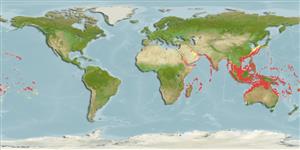
Indo-Pacific: Red Sea and East Africa to the Marquesas and Line islands, north to southern Japan, south to Australia. Southeast Atlantic: East London, South Africa (Ref. 5484).
Length at first maturity / Size / Weight / Age
Maturity: Lm 20.5, range 17 - 25 cm
Max length : 40.0 cm TL male/unsexed; (Ref. 4883); common length : 25.0 cm TL male/unsexed; (Ref. 55)
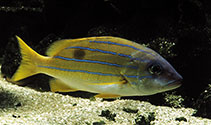
Adults inhabit coral reefs, occurring in both shallow lagoons and on outer reef slopes. Frequently found in large aggregations around coral formation, caves or wrecks during the day. Juveniles inhabit seagrass beds around patch reefs (Ref. 9710). Benthopelagic (Ref. 58302). Feed on fishes, shrimps, crabs, stomatopods, cephalopods, and planktonic crustaceans. Also take a variety of algae (Ref. 4821). Minimum depth reported taken from Ref. 30874.
Allen, G.R., 1985. FAO Species Catalogue. Vol. 6. Snappers of the world. An annotated and illustrated catalogue of lutjanid species known to date. FAO Fish. Synop. 125(6):208 p. Rome: FAO. (Ref. 55)
IUCN Red List Status (Ref. 130435)
Threat to humans
Harmless
Human uses
Fisheries: commercial; gamefish: yes; aquarium: commercial
Tools
Special reports
Download XML
Internet sources
Estimates based on models
Preferred temperature (Ref.
123201): 19.1 - 28.3, mean 26.4 °C (based on 1181 cells).
Phylogenetic diversity index (Ref.
82804): PD
50 = 0.5000 [Uniqueness, from 0.5 = low to 2.0 = high].
Bayesian length-weight: a=0.01479 (0.01304 - 0.01678), b=2.97 (2.95 - 2.99), in cm total length, based on LWR estimates for this species (Ref.
93245).
Trophic level (Ref.
69278): 3.9 ±0.3 se; based on diet studies.
Resilience (Ref.
120179): Medium, minimum population doubling time 1.4 - 4.4 years (K=0.21-0.38).
Prior r = 0.56, 95% CL = 0.37 - 0.85, Based on 1 stock assessment.
Fishing Vulnerability (Ref.
59153): Moderate vulnerability (40 of 100).
Climate Vulnerability (Ref.
125649): Moderate to high vulnerability (50 of 100).
Nutrients (Ref.
124155): Calcium = 32.2 [20.6, 44.6] mg/100g; Iron = 0.315 [0.209, 0.480] mg/100g; Protein = 18.3 [16.8, 19.6] %; Omega3 = 0.154 [0.114, 0.203] g/100g; Selenium = 74.6 [51.2, 104.5] μg/100g; VitaminA = 174 [34, 624] μg/100g; Zinc = 0.462 [0.381, 0.625] mg/100g (wet weight); based on
nutrient studies.