Environment: milieu / climate zone / depth range / distribution range
Ecology
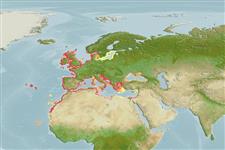
Marine; freshwater; brackish; pelagic-neritic; catadromous (Ref. 59043); depth range 10 - 20 m (Ref. 30578). Temperate; 60°N - 15°N, 32°W - 42°E
Eastern Atlantic: from the coasts of southern Norway to Cape Verde, including the Mediterranean and the Black Sea (Ref. 2804, Ref. 51442, 116118). Records of its occurrence in tropical waters are based on misidentifications (Ref. 3573).
Length at first maturity / Size / Weight / Age
Maturity: Lm 25.9, range 25 - 32 cm
Max length : 70.0 cm TL male/unsexed; (Ref. 4645); common length : 35.0 cm TL male/unsexed; (Ref. 3646); max. published weight: 2.9 kg (Ref. 40476); max. reported age: 10 years (Ref. 40476)
Dorsal
spines
(total): 4 - 5;
Dorsal
soft rays
(total): 7-10;
Anal
spines: 3;
Anal
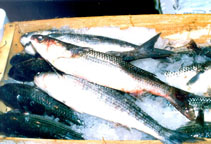
soft rays: 8 - 9. Fusiform body (Ref. 51442). Massive head, flattened above the eyes (Ref. 51442). Small mouth (Ref. 51442). Snout short and blunt (Ref. 51442). Two dorsal fins well-separated, the first with 4 to 5 spines (Ref. 40476, Ref. 51442). Pectoral fins are placed high on the flanks (Ref. 51442). Large scales (Ref. 51442). Dorsal sides and flanks gray-colored, ventral side white (Ref. 51442).
Adults are pelagic occurring near shore, entering lagoons and lower reaches of rivers in schools; often in polluted waters (Ref. 51442, 59043) between temperatures 8-24°C. Juveniles colonize the littoral zone and estuaries (Ref. 51442). Adults feed on epiphytic algae, detritus and small benthic or planktonic organisms, pelagic eggs and larvae while juveniles feed on zooplankton until about 3.0 cm SL, then on benthic animals and plants (Ref. 59043). Spawning takes place at sea near the coast between September and February (Ref. 30578, 51442). Oviparous, eggs are pelagic and non-adhesive (Ref. 205). Adults undergo migrations (Ref. 51442).
Spawning takes place at sea near the coast by gathering in groups between September and February (Ref. 51442). The eggs develop at sea (Ref. 51442). The juveniles then colonize the littoral zone and the estuaries (Ref. 51442). Adults enter the lower parts of the rivers and treturn to the sea to spawn (Ref. 51442).
Thomson, J.M., 1990. Mugilidae. p. 855-859. In J.C. Quero, J.C. Hureau, C. Karrer, A. Post and L. Saldanha (eds.) Check-list of the fishes of the eastern tropical Atlantic (CLOFETA). JNICT, Lisbon; SEI, Paris; and UNESCO, Paris. Vol. 2. (Ref. 7399)
IUCN Red List Status (Ref. 130435)
Threat to humans
Harmless
Human uses
Fisheries: commercial; aquaculture: commercial; gamefish: yes
Tools
Special reports
Download XML
Internet sources
Estimates based on models
Preferred temperature (Ref.
123201): 9.7 - 20.1, mean 11.8 °C (based on 314 cells).
Phylogenetic diversity index (Ref.
82804): PD
50 = 0.5005 [Uniqueness, from 0.5 = low to 2.0 = high].
Bayesian length-weight: a=0.00933 (0.00743 - 0.01172), b=2.96 (2.93 - 2.99), in cm total length, based on LWR estimates for this species (Ref.
93245).
Trophic level (Ref.
69278): 2.3 ±0.20 se; based on food items.
Generation time: 4.4 (3.2 - 7.3) years. Estimated as median ln(3)/K based on 10
growth studies.
Resilience (Ref.
120179): Low, minimum population doubling time 4.5 - 14 years (K=0.15; tm=3-5).
Fishing Vulnerability (Ref.
59153): Moderate vulnerability (42 of 100).
Nutrients (Ref.
124155): Calcium = 16.3 [5.2, 148.0] mg/100g; Iron = 0.275 [0.165, 0.453] mg/100g; Protein = 18.2 [16.9, 19.7] %; Omega3 = 1.14 [0.46, 2.94] g/100g; Selenium = 3.21 [1.26, 8.34] μg/100g; VitaminA = 8.98 [2.20, 38.02] μg/100g; Zinc = 0.485 [0.343, 0.670] mg/100g (wet weight); based on
nutrient studies.