Teleostei (teleosts) >
Eupercaria/misc (Various families in series Eupercaria) >
Lethrinidae (Emperors or scavengers) > Lethrininae
Etymology: Lethrinus: Greek, lethrinia, a fish pertaining to genus Pagellus.
More on author: Valenciennes.
Environment: milieu / climate zone / depth range / distribution range
Ecology
Marine; reef-associated; non-migratory; depth range 5 - 30 m (Ref. 90102). Tropical; 29°N - 8°S
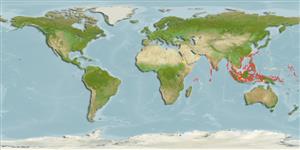
Indo-West Pacific: Chagos, West Thailand, Ryukyu Islands, the Philippines to Irian Jaya, Indonesia.
Size / Weight / Age
Maturity: Lm ? range ? - ? cm
Max length : 40.0 cm TL male/unsexed; (Ref. 2295)
Dorsal
spines
(total): 10;
Dorsal
soft rays
(total): 9;
Anal
spines: 3;
Anal
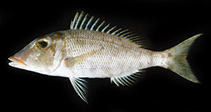
soft rays: 8. Body color is olive gray or tan, often with scattered irregular black blotches. The head is brown or olive with an indistinct reddish band on the snout. The base of the pectoral fin, the upper edge of the operculum and sometimes the posterior edge of the preoperculum are red.
Solitary or in groups (Ref. 90102). Thought to occur on soft bottoms near reefs and presumed to feed on benthic invertebrates and fish. Marketed fresh.
Life cycle and mating behavior
Maturity | Reproduction | Spawning | Eggs | Fecundity | Larvae
Carpenter, K.E. and G.R. Allen, 1989. FAO Species Catalogue. Vol. 9. Emperor fishes and large-eye breams of the world (family Lethrinidae). An annotated and illustrated catalogue of lethrinid species known to date. FAO Fish. Synop. 125(9):118 p. Rome: FAO. (Ref. 2295)
IUCN Red List Status (Ref. 130435)
Threat to humans
Harmless
Human uses
Fisheries: minor commercial
More information
Common namesSynonymsMetabolismPredatorsEcotoxicologyReproductionMaturitySpawningSpawning aggregationFecundityEggsEgg development
ReferencesAquacultureAquaculture profileStrainsGeneticsElectrophoresesHeritabilityDiseasesProcessingNutrientsMass conversion
Tools
Special reports
Download XML
Internet sources
Estimates based on models
Preferred temperature (Ref.
123201): 26 - 29.3, mean 28.8 °C (based on 1537 cells).
Phylogenetic diversity index (Ref.
82804): PD
50 = 0.5000 [Uniqueness, from 0.5 = low to 2.0 = high].
Bayesian length-weight: a=0.01514 (0.00706 - 0.03245), b=2.98 (2.81 - 3.15), in cm total length, based on LWR estimates for this Genus-body shape (Ref.
93245).
Trophic level (Ref.
69278): 3.6 ±0.2 se; based on diet studies.
Resilience (Ref.
120179): Medium, minimum population doubling time 1.4 - 4.4 years (Preliminary K or Fecundity.).
Fishing Vulnerability (Ref.
59153): Low to moderate vulnerability (30 of 100).