Petromyzonti (lampreys) >
Petromyzontiformes (Lampreys) >
Petromyzontidae (Northern lampreys) > Lampetrinae
Etymology: Lethenteron: Etymology not explained, perhaps lethalis (L.), lethal, or lethe (Gr.), forgetting or forgetfulness; enteron (Gr.) intestine, presumably referring to “degenerate and non-functional” intestine of adult L. appendix. (See ETYFish); camtschaticum: -icum (Gr.), belonging to: the Kamchatka, Russia, type locality. (See ETYFish).
Environment: milieu / climate zone / depth range / distribution range
Ecology
Marine; freshwater; brackish; demersal; anadromous (Ref. 89241); depth range 0 - 50 m (Ref. 50610). Boreal; 5°C - 18°C (Ref. 12468); 72°N - 34°N, 180°W - 180°E (Ref. 26213)
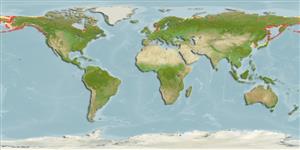
Arctic: Siberian coast to Anderson River in Canada. Northwest Pacific: Bering Sea south to Japan and Korea. Freshwater resident populations in Slave, Hay and Mackenzie rivers, Northern Territories, Canada. Freshwater non-migratory stocks in river systems in Mongolia (Ref. 41072). Europe: Arctic, White and Barents Sea basins of Russia and Norway, from Pechora drainage in Russia to Pasvik drainage in Norwegian-Russian border (Ref. 59043). In danger of local extinctions due to pollution and use as bait (Ref. 12321).
Length at first maturity / Size / Weight / Age
Maturity: Lm 22.5, range 13 - 32 cm
Max length : 63.0 cm TL male/unsexed; (Ref. 56557); common length : 16.1 cm TL male/unsexed; (Ref. 12193); max. published weight: 200.00 g (Ref. 56557); max. reported age: 7 years (Ref. 12321)
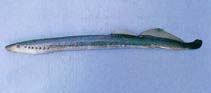
Characterized by 2 large teeth on the supraoral bars, the presence of only 2 points on the central pair of lateral tooth plates, and the presence of a row of posterial teeth (Ref. 27547). Dorsal fins arise far back on body, the anterior dorsal lower than the posterior, the fins higher in males; lower lobe of caudal fin is somewhat larger than upper, the fin joined to both dorsal and anal fins; anal fin small, in males represented only by a low ridge (Ref. 27547). Color ranges from brown to olive to grayish above, paler below (Ref. 27547). The non-anadromous form rarely grows larger than 18 cm (Ref. 27547). Other adult diagnostic features: 11.0-62.5 cm TL. Wet weight of individuals 14.5-35.0 cm TL, 3.2-87.7 g. Body proportions, as percentage of TL (based on 63 specimens measuring 13-46 cm TL): prebranchial length, 7.3-21.3; branchial length, 7.8-20.8; trunk length, 21.9-56.3; tail length, 24.6-30.8; eye length, 0.7-3.7; disc length, 4.5-7.7. Intestinal diameter up to 13 mm. Urogenital papilla length, as a percentage of branchial length, in 6 spawning males measuring 33.9-40.1 cm TL, 14.6-19.5. Trunk myomeres, 65-77 [Kucheryavyi et al. (2007) reported counts of 63-85 for 19 downstream migrants and 55-79 for 87 anadromous individuals from Utkholok River Basin, Kamchatka]. Dentition: supraoral lamina, 2 unicuspid, rarely bicuspid, teeth; infraoral lamina, 6-10 teeth, usually 8 (as few as 5), the lateralmost tooth on either end usually bicuspid, the internal ones unicuspid; usually 3, rarely 4 endolaterals on each side; endolateral formula typically 2-2-2 with variant formulae, 2-2-1, 2-2-2-2, 2-2-2-1; 3 rows of anterials; first row of anterials, 3 unicuspid teeth; total number of anterials, 20-33 teeth [5-43 according to Kucheryavyi et al. (2007) and as low as 11 according to Iwata et al. (1985), which may be due to regional effects, but this requires further investigation]; exolaterals absent; single row of posterials, 12-28 teeth; transverse lingual lamina, 13-18 teeth, the median one greatly enlarged; longitudinal lingual laminae each with 10-14 teeth. Velar tentacles, 5-7, with tubercles and with the single median tentacle shorter than the lateral tentacles immediately next to it, and with dorsal velar wings on either side, each consisting of a single tentacle. Body coloration (live) of recently transformed adults brown on dorsal and lateral aspects and silvery on ventral aspect, while upstream spawning migrants have a yellowish olive dorsal aspect, becoming lighter on the lateral aspects, and dull yellowish on the ventral aspect. Lateral line neuromasts unpigmented. Gular region unpigmented. Second dorsal fin with a dark blotch near the apex. Extent of caudal fin pigmentation, 1% to <25% (29% of specimens), 25% to <75% (57%) or, 75% or more (14%). Caudal fin shape, spade-like. Oral fimbriae, 87-112. Oral papillae, 12-22 (Ref. 89241).
In fresh waters, occurs in rivers and lakes (Ref. 89241). Adults inhabit coastal and estuarine waters (Ref. 59043). Ammocoetes occur along river banks in silty-muddy substrate where current is slight (Ref. 89241). Prefer sites with stony or sandy bottom, shaded by riparian vegetation (Ref. 41072). Spawning adults found in gravel riffles and runs of clear streams; feeding adults usually in oceans or lakes; ammocoetes in muddy margins and backwaters of river and lakes (Ref. 5723). Spawning occurs on pebble-sand substrate (Ref. 89241). Anadromous (Ref. 58426, 89241). The Great Slave Lake Basin population is believed to be a permanent freshwater resident population (Ref. 89241). There are non-migratory freshwater populations. Probably parasitizes any species of fish of suitable size (Ref. 27547), including commercial species (Ref. 58426). Subadults are non-parasitic (Ref. 12218). Feed on small aquatic invertebrates, algae and organic matter contained in detritus (Ref. 41072). Larval period lasts 4 years. Age classes range in total length approximately as follows: 0+ up to 35 mm; 1+ 30-65 mm; 2+ 60-155 mm; 3+ 150-220 mm. They tend to disperse downstream as they age. Mean densities in the Hay River, Northwest Territories, have been estimated at 137 ammocoetes/m2. Larvae feed mainly on organic detritus and algae. Ammocoetes are preyed upon by fishes. Metamorphosis begins in late summer (mid-August) and continues through the winter in Great Slave Lake Basin, Northwest Territories, Canada and recently metamorphosed adults enter the lake in May to July. Downstream movement of recently metamorphosed adults towards the sea begins in late May and ends in July in Kamchatka. Adults parasitic on various fishes in both fresh and marine waters. The site of attachment is usually below the lateral line and anterior to the pelvic fins. Adults are preyed upon by fishes and birds (gulls). Spawning adults ascend rivers in Japan between October and January, while this occurs between the end of May and June in Utkholok River Basin, Kamchatka, and between the end of November and the end of April in the Yukon River, Alaska. The spawning migration distance up the Yukon River exceeds 1,600 km. Both sexes participate in the building of the oval-shaped redd. Spawning occurs in June in Utkholok River Basin, Kamchatka, from April to July in Japan and mid June - early July in Great Slave Lake Basin, Canada. Fecundity, 9,790-29,780 eggs/female in Great Slave Lake Basin (believed to be a permanent freshwater resident population), 12,272-34,586 eggs/female in an anadromous population from Kamchatka, and 62,936-119,180 eggs/female in anadromous populations from rivers in Japan. In the latter case, the long diameter of the eggs varies from 0.85 to 1.23 mm and the short diameter from 0.75 to 1.14 mm. The eggs are dark blue and adhesive. When they emerge from the egg after about a one-month incubation period, larvae measure about 7 mm total length. Adult life is about two years (Ref. 89241). Arctic lamprey has high quality flesh rich in fat (Ref. 41072). Around 1879 it was of great importance for native peoples along the Yukon River at Russian Mission and Anvik, Alaska, where they would catch upstream spawning migrants by the dozens through the ice using long multi-forked poles or dipnets (Turner, 1886, Nelson, 1887). The oil in the lamprey would be rendered through boiling in water and used for human food or in lamps as a substitute for seal oil. Recently, there has been an interest in starting a commercial fishery for upstream migrants targeting the Asian market in the USA and abroad in addition to the traditional subsistence harvest. The 2003 quota was set at 20,000 kg. The taste has been compared to that of sardine because of the high lipid content that can reach 38% of the body weight. In Japan, in the Shinano River estuary, upstream spawning migrants are caught between October and January using large handnets; in 1959, daily catches varied from a few dozen to over 1,000 lampreys (Honma 1960). In winter, lampreys are caught at the same place but using a gang of about ten bell-shaped leather fishing traps that is laid in a string along the river floor (Honma, 1960). The lampreys are served in a number of different ways in restaurants, and in salt-dried form are highly valued as a medicine against night blindness (Honma, 1960) (Ref. 89241).
Both male and female engage in nest building, removing pebbles and small rocks from the stream bottom. The male uses his sucker to attach himself to the head of the female. The pair arch their bodies and the male wraps himself around the female. Both of the lampreys vibrate rapidly and eggs and sperm are extruded into the nest. Two males may simultaneously mate with a single female. A female will mate several times before her egg supply is exhausted, usually with several males. Ammocoetes spend one to two years in this stage. Upon metamorphosis (occurring from fall through winter, Ref. 12218), the young adults descend the stream to the sea or lakes or larger rivers (occurring in springtime, Ref. 12218) (Ref. 27547).
Kottelat, M., 1997. European freshwater fishes. An heuristic checklist of the freshwater fishes of Europe (exclusive of former USSR), with an introduction for non-systematists and comments on nomenclature and conservation. Biologia, Bratislava, 52/Suppl. 5:1-271. (Ref. 13696)
IUCN Red List Status (Ref. 130435)
Threat to humans
Harmless
Human uses
Fisheries: commercial; aquaculture: commercial; bait: usually
More information
ReferencesAquacultureAquaculture profileStrainsGeneticsElectrophoresesHeritabilityDiseasesProcessingNutrientsMass conversion
Tools
Special reports
Download XML
Internet sources
Estimates based on models
Preferred temperature (Ref.
123201): 0.8 - 10.1, mean 2.6 °C (based on 603 cells).
Phylogenetic diversity index (Ref.
82804): PD
50 = 0.5039 [Uniqueness, from 0.5 = low to 2.0 = high].
Bayesian length-weight: a=0.00148 (0.00112 - 0.00195), b=3.02 (2.94 - 3.10), in cm total length, based on LWR estimates for this species (Ref.
93245).
Trophic level (Ref.
69278): 4.3 ±0.88 se; based on food items.
Resilience (Ref.
120179): Low, minimum population doubling time 4.5 - 14 years (tm 4-5).
Fishing Vulnerability (Ref.
59153): Moderate to high vulnerability (45 of 100).