Teleostei (teleosts) >
Centrarchiformes (Basses) >
Centrarchidae (Sunfishes)
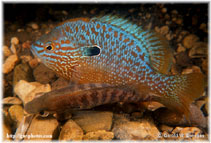
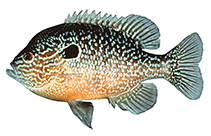
Etymology: Lepomis: Greek, lepis = scaled + Greek, poma = gill cover, operculum (Ref. 45335, 79012); megalotis: megalotis meaning great ear, referring to the large opercular lobe (Ref. 10294).
More on author: Rafinesque.
Issue
Lepomis peltastes Cope, 1870 is considered as a valid species in Page & Burr (2011: Ref. 86798).
Environment: milieu / climate zone / depth range / distribution range
Ecology
Freshwater; benthopelagic. Temperate; 51°N - 26°N
North America: northeastern Mexico and north to the Great Lakes.
Size / Weight / Age
Maturity: Lm ? range ? - ? cm
Max length : 24.0 cm TL male/unsexed; (Ref. 5723); common length : 11.5 cm TL male/unsexed; (Ref. 4543); max. published weight: 790.00 g (Ref. 4699); max. reported age: 6 years (Ref. 12193)
Nearly always found in shallow water, preferring habitats with dense vegetation in small lakes, ponds and slow moving rivers and streams. Feed on small aquatic invertebrates, insects, and occasionally small fishes. (Ref. 4543, 10294).
Life cycle and mating behavior
Maturity | Reproduction | Spawning | Eggs | Fecundity | Larvae
Nests side by side arranged in dense colonies near shore. Male digs nest and defends territory during prespawning period. Female approaches nesting colony when nest completed. Mating pairs swim in circles over nest, stop for short intervals to release sperm and egg. Male may chase mate away from nest, female may come back to same nest or move on to mate with another (Ref 4543).
Page, L.M. and B.M. Burr, 1991. A field guide to freshwater fishes of North America north of Mexico. Houghton Mifflin Company, Boston. 432 p. (Ref. 5723)
IUCN Red List Status (Ref. 130435)
Threat to humans
Harmless
Human uses
Aquarium: public aquariums
More information
ReferencesAquacultureAquaculture profileStrainsGeneticsElectrophoresesHeritabilityDiseasesProcessingNutrientsMass conversion
Tools
Special reports
Download XML
Internet sources
Estimates based on models
Phylogenetic diversity index (Ref.
82804): PD
50 = 0.5001 [Uniqueness, from 0.5 = low to 2.0 = high].
Bayesian length-weight: a=0.01479 (0.01100 - 0.01990), b=3.12 (3.07 - 3.17), in cm total length, based on LWR estimates for this species (Ref.
93245).
Trophic level (Ref.
69278): 3.6 ±0.52 se; based on food items.
Resilience (Ref.
120179): Medium, minimum population doubling time 1.4 - 4.4 years (K=0.14-0.24; tmax=6).
Fishing Vulnerability (Ref.
59153): Moderate to high vulnerability (50 of 100).