Petromyzonti (lampreys) >
Petromyzontiformes (Lampreys) >
Petromyzontidae (Northern lampreys) > Lampetrinae
Etymology: Lampetra: lambo (L.), to lick; petra (Gr.), rock or stone, referring to their suctorial behavior (adults attach to rocks during nest building and mating). (See ETYFish); ayresii: In honor of physician-ichthyologist William O. Ayres (1817-1887), founding member of the California Academy of Sciences, who described this species in 1855 but used a preoccupied name (Petromyzon plumbeus). (See ETYFish).
More on author: Günther.
Environment: milieu / climate zone / depth range / distribution range
Ecology
Marine; freshwater; brackish; demersal; anadromous (Ref. 89241). Temperate; 59°N - 37°N
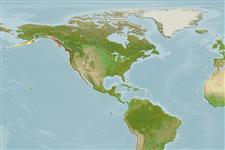
Eastern Pacific: Tee Harbor, Alaska to Sacramento-San Joaquin drainage in California, USA. Freshwater resident population in Morrison Creek, Vancouver Island, British Columbia (Ref. 12269).
Length at first maturity / Size / Weight / Age
Maturity: Lm 16.2 range ? - ? cm
Max length : 28.1 cm TL male/unsexed; (Ref. 1998); 31.1 cm TL (female); common length : 20.5 cm TL male/unsexed; (Ref. 12193)
Short description
Morphology | Morphometrics
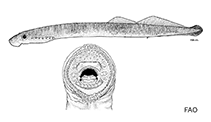
Distinguished by 2 large teeth on the supraoral bar, a large middle tooth on the tongue, 3 points (rarely 2) on each central lateral tooth plate, and the absence of posterial teeth (Ref. 27547). Anterior dorsal fin being lower than posterior, the fins separate in nonbreeding individuals but coming into contact at spawning; caudal fin lobes about equal, lower lobe joined to anal fin; anal fin virtually absent in males (Ref. 27547). Dark brown or brownish gray on sides and back; belly yellowish, silvery around head, gill openings and lower sides; caudal fin has a band of dark pigment inside its margins, symmetrical on each lobe (Ref. 27547). Other diagnostic features: Adults: 11.4-31.1 cm TL. Body wet weight in individuals 17.5-23.0 cm TL, 20-24 g. Body proportions, as percentage of TL (based on 68 specimens measuring 11.7-31.1 cm TL): prebranchial length, 10.9-14.1; branchial length, 7.8-11.8; trunk length, 45.9-55.9; tail length, 24.4-29.5; eye length, 2.3-4.3; disc length, 4.7-7.2. The urogenital papilla length, as a percentage of branchial length, in two spawning males measuring 17.4-18.7 cm TL, 10.3-12.5. Trunk myomeres, 60-71. Dentition: supraoral lamina, 2 unicuspid teeth; infraoral lamina, 7-10 teeth, the lateralmost often bicuspid, the others unicuspid; 3 endolaterals on each side; endolateral formula, typically 2-3-2, very rarely 2-2-2; 3 rows of anterials; first row of anterials, 4 unicuspid teeth; exolaterals absent; posterials absent; transverse lingual lamina, 12-17 unicuspid teeth, the median one greatly enlarged; longitudinal lingual laminae each with 9-12 unicuspid teeth. Velar tentacles, 3-5, with tubercles. Body coloration in marine waters (live), lead gray on dorsal and upper lateral aspects, silvery on the lateral aspect, and white on the ventral aspect. Body coloration (preserved), dorsal and lateral aspects brownish gray and ventral aspect whitish. Lateral line neuromasts unpigmented. Extent of caudal fin pigmentation, 25% to more than 75%. Caudal fin shape, spade-like or rounded. Oral fimbriae, 88-117. Oral papillae, 12-18 (Ref. 89241).
Anadromous. A permanent freshwater resident population is believed to occur in Morrison Creek, British Columbia. In marine waters, they inhabit surface waters. In fresh waters, they occur in lakes, rivers, and creeks. They leave rivers to enter the sea in late spring or early summer, where they actively feed throughout the summer, and return to the rivers in the fall (Ref. 89241). Parasitic adults are found in estuaries and the ocean, migrating to clear gravel riffles of streams to spawn (Ref. 5723). Ammocoetes burrow into the mud where they live for an unknown period and migrate to the sea only after transformation (Ref. 1998). Adults feed by ripping flesh from other fishes (Ref. 2850), ammocoetes feed on microscopic plants and animals just like other members of this family (Ref. 1998). Parasitism can take place at a length of 16.2 cm TL (Ref. 1998). Preyed upon by a number of fishes, e.g. lingcod, and birds (Ref. 1998). In the Sacramento River, California, the spawning season is thought to be from late April into May. Fecundity, 11,398-37,288 eggs/female. Egg diameter, 0.6-0.7 mm (Ref. 89241). Because of its small size, it is unlikely to pose a threat to economically important fish (Ref. 1998). Utilized fresh or smoked by some cultures (Ref. 27436).
Probably spawns in gravel, with an activity similar to Lethenteron japonicum (Ref. 1998).
Page, L.M. and B.M. Burr, 1991. A field guide to freshwater fishes of North America north of Mexico. Houghton Mifflin Company, Boston. 432 p. (Ref. 5723)
IUCN Red List Status (Ref. 130435)
Threat to humans
Harmless
Human uses
Fisheries: minor commercial
More information
Age/SizeGrowthLength-weightLength-lengthLength-frequenciesMorphometricsMorphologyLarvaeLarval dynamicsRecruitmentAbundanceBRUVS
ReferencesAquacultureAquaculture profileStrainsGeneticsElectrophoresesHeritabilityDiseasesProcessingNutrientsMass conversion
Tools
Special reports
Download XML
Internet sources
Estimates based on models
Preferred temperature (Ref.
123201): 8.6 - 11.7, mean 9.6 °C (based on 64 cells).
Phylogenetic diversity index (Ref.
82804): PD
50 = 0.5002 [Uniqueness, from 0.5 = low to 2.0 = high].
Bayesian length-weight: a=0.00126 (0.00056 - 0.00284), b=2.99 (2.80 - 3.18), in cm total length, based on LWR estimates for this (Sub)family-body shape (Ref.
93245).
Trophic level (Ref.
69278): 4.5 ±0.80 se; based on food items.
Resilience (Ref.
120179): Low, minimum population doubling time 4.5 - 14 years (Fec=11,398).
Fishing Vulnerability (Ref.
59153): Low vulnerability (21 of 100).