Teleostei (teleosts) >
Carangiformes (Jacks) >
Istiophoridae (Billfishes)
Etymology: Istiophorus: Greek, istios = sail + Greek, pherein = to carry (Ref. 45335).
Issue
This species is synonym of Istiophorus platypterus in Eschmeyer (CofF ver. Jan. 2018) according to Collette et al., 2006 (Ref. 84358). Several authors consider it as a valid species.
Environment: milieu / climate zone / depth range / distribution range
Ecology
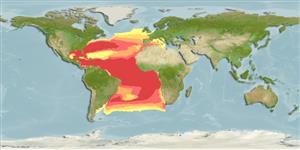
Marine; pelagic-oceanic; oceanodromous (Ref. 51243); depth range 0 - 200 m (Ref. 43). Subtropical; 21°C - 28°C (Ref. 43); 56°N - 55°S, 99°W - 18°E (Ref. 43)
Atlantic Ocean: in tropical and temperate waters approximately 40°N in the northwest Atlantic, 50°N in the northeast Atlantic, 40°S in the southwest Atlantic, and 32°S in the southeast Atlantic. Migrating to Mediterranean Sea, mostly based on juvenile specimens. Highly migratory species.
Length at first maturity / Size / Weight / Age
Maturity: Lm 133.5, range 121 - 146 cm
Max length : 315 cm TL male/unsexed; (Ref. 43); common length : 240 cm TL male/unsexed; (Ref. 5217); max. published weight: 58.1 kg (Ref. 43); max. reported age: 4 years (Ref. 72497)
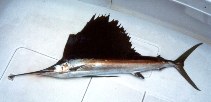
Usually found in the upper layers of warm water above the thermocline, but also capable of descending to rather deep water. Often migrate into near-shore waters. Occasionally form schools or smaller groups of 3 to 30 individuals, but often occur in loose aggregations over a wide area. Feed mainly on small pelagic fishes but also takes bottom-dwelling organisms. Females grow larger (Ref. 4770). Utilized fresh, canned and frozen; eaten steamed (Ref. 9987).
Around Florida in USA, this species often moves inshore into shallow waters where females, swimming sluggishly with their dorsal fins extended and accompanied each by one or more males, may spawn near the surface in the warm season. However, spawning in offshore waters beyond the 100 fathom isobath was also reported from south of Cuba to Carolina, USA. Off southeast Florida, a 33.4 kg female may shed up to 4.8 million eggs in three batches during one spawning season.
Nakamura, I., 1985. FAO species catalogue. Vol. 5. Billfishes of the world. An annotated and illustrated catalogue of marlins, sailfishes, spearfishes and swordfishes known to date. FAO Fish. Synop. 125(5):65p. Rome: FAO. (Ref. 43)
IUCN Red List Status (Ref. 130435)
Threat to humans
Harmless
Human uses
Fisheries: commercial; gamefish: yes
More information
ReferencesAquacultureAquaculture profileStrainsGeneticsElectrophoresesHeritabilityDiseasesProcessingNutrientsMass conversion
Tools
Special reports
Download XML
Internet sources
Estimates based on models
Preferred temperature (Ref.
123201): 16.3 - 27.4, mean 23.5 °C (based on 431 cells).
Phylogenetic diversity index (Ref.
82804): PD
50 = 0.7505 [Uniqueness, from 0.5 = low to 2.0 = high].
Bayesian length-weight: a=0.00447 (0.00193 - 0.01034), b=3.14 (2.94 - 3.34), in cm total length, based on LWR estimates for this (Sub)family-body shape (Ref.
93245).
Trophic level (Ref.
69278): 4.5 ±0.4 se; based on diet studies.
Generation time: 5.4 ( na - na) years. Estimated as median ln(3)/K based on 2
growth studies.
Resilience (Ref.
120179): Medium, minimum population doubling time 1.4 - 4.4 years (K=0.29-1.2 (?); tm=3.5).
Prior r = 0.24, 95% CL = 0.16 - 0.36, Based on 1 stock assessment.
Fishing Vulnerability (Ref.
59153): High vulnerability (60 of 100).
Climate Vulnerability (Ref.
125649): Moderate vulnerability (42 of 100).
Nutrients (Ref.
124155): Calcium = 27.7 [13.8, 44.3] mg/100g; Iron = 0.872 [0.523, 1.431] mg/100g; Protein = 19.5 [18.4, 20.6] %; Omega3 = 0.212 [0.117, 0.376] g/100g; Selenium = 43.5 [23.2, 80.1] μg/100g; VitaminA = 6.84 [2.30, 19.89] μg/100g; Zinc = 0.373 [0.265, 0.532] mg/100g (wet weight);