Teleostei (teleosts) >
Syngnathiformes (Pipefishes and seahorses) >
Syngnathidae (Pipefishes and seahorses) > Syngnathinae
Etymology: Hippocampus: Greek, ippos = horse + Greek,kampe = curvature (Ref. 45335).
More on authors: Jordan & Gilbert.
Environment: milieu / climate zone / depth range / distribution range
Ecology
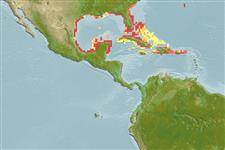
Marine; demersal; non-migratory; depth range 0 - 10 m (Ref. 52034). Subtropical; 33°N - 17°N, 99°W - 64°W
Western Atlantic: Bermuda, southern Florida (USA), Bahamas and the entire Gulf of Mexico.
Length at first maturity / Size / Weight / Age
Maturity: Lm 2.1 range ? - ? cm
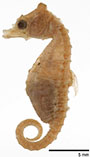
Max length : 5.0 cm TL male/unsexed; (Ref. 7251); max. reported age: 1.00 years (Ref. 12238)
Short description
Morphology | Morphometrics
Shallow grass flats, especially in association with Zostera and other seagrass; periodically found in floating vegetation. Diurnal, males more site faithful than females. Ovoviviparous (Ref. 205). The male carries the eggs in a brood pouch which is found under the tail (Ref. 205). Specimens lose their skin filaments in aquaria (Ref. 30915). Has been reared in captivity (Ref. 35420). Maximum depth reported taken from Ref. 128812.
Monogamous mating is observed as both obligate and genetic (Ref. 52884). Male carries the eggs in a brood pouch (Ref. 205). Female transfers all the eggs in the ovary to the brood pouch of the male (Ref. 1284).
Lourie, S.A., R.A. Pollom and S.J. Foster, 2016. A global revision of the seahorses Hippocampus Rafinesque 1810 (Actinopterygii: Syngnathiformes): taxonomy and biogeography with recommendations for further research. Zootaxa 4146(1):1-66. (Ref. 115213)
IUCN Red List Status (Ref. 130435)
Threat to humans
Harmless
Human uses
Fisheries: minor commercial
More information
ReferencesAquacultureAquaculture profileStrainsGeneticsElectrophoresesHeritabilityDiseasesProcessingNutrientsMass conversion
Tools
Special reports
Download XML
Internet sources
Estimates based on models
Preferred temperature (Ref.
123201): 23.4 - 27.8, mean 26.6 °C (based on 229 cells).
Phylogenetic diversity index (Ref.
82804): PD
50 = 0.5000 [Uniqueness, from 0.5 = low to 2.0 = high].
Bayesian length-weight: a=0.00447 (0.00177 - 0.01127), b=3.00 (2.78 - 3.22), in cm total length, based on LWR estimates for this (Sub)family-body shape (Ref.
93245).
Trophic level (Ref.
69278): 3.2 ±0.5 se; based on size and trophs of closest relatives
Resilience (Ref.
120179): Medium, minimum population doubling time 1.4 - 4.4 years (tm=0.4; tmax=1; assuming Fec=100 (approx. 3 generations/year)).
Fishing Vulnerability (Ref.
59153): Low vulnerability (10 of 100).