Teleostei (teleosts) >
Syngnathiformes (Pipefishes and seahorses) >
Syngnathidae (Pipefishes and seahorses) > Syngnathinae
Etymology: Hippocampus: Greek, ippos = horse + Greek,kampe = curvature (Ref. 45335).
Environment: milieu / climate zone / depth range / distribution range
Ecology
Marine; reef-associated; non-migratory; depth range 0 - 32 m (Ref. 128812). Tropical; 15°N - 10°S, 91°E - 128°E
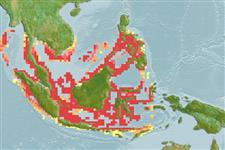
Indo-West Pacific: India (Andaman Islands), Indonesia, Malaysia, Philippines, Singapore, Thailand, Viet Nam. Confused with Hippocampus kuda.
Length at first maturity / Size / Weight / Age
Maturity: Lm 8.1 range ? - ? cm
Max length : 18.7 cm OT male/unsexed; (Ref. 52034)
Length type refers to Height (= from top of coronet to the tip of straightened tail). This species is mainly found in pairs (Ref. 48635) on coral reefs, sponge gardens, kelp, and floating Sargassum. Nocturnal, site faithful. Feeds on zooplankton (Ref. 85309). Ovoviviparous (Ref. 205). The male carries the eggs in a brood pouch which is found under the tail (Ref. 205). Life span probably more than 2-3 years. Used for traditional Chinese medicine (Ref. 85309).
Monogamous mating is observed as both obligate and genetic (Ref. 52884). Male carries the eggs in a brood pouch (Ref. 205). Gestation period 2-3 weeks (but varies with water temperature) (Ref. 30915).
Lourie, S.A., R.A. Pollom and S.J. Foster, 2016. A global revision of the seahorses Hippocampus Rafinesque 1810 (Actinopterygii: Syngnathiformes): taxonomy and biogeography with recommendations for further research. Zootaxa 4146(1):1-66. (Ref. 115213)
IUCN Red List Status (Ref. 130435)
Threat to humans
Harmless
Human uses
Fisheries: commercial; aquarium: commercial
More information
ReferencesAquacultureAquaculture profileStrainsGeneticsElectrophoresesHeritabilityDiseasesProcessingNutrientsMass conversion
Tools
Special reports
Download XML
Internet sources
Estimates based on models
Preferred temperature (Ref.
123201): 28.3 - 29.3, mean 28.8 °C (based on 688 cells).
Phylogenetic diversity index (Ref.
82804): PD
50 = 0.5000 [Uniqueness, from 0.5 = low to 2.0 = high].
Bayesian length-weight: a=0.00447 (0.00177 - 0.01127), b=3.00 (2.78 - 3.22), in cm total length, based on LWR estimates for this (Sub)family-body shape (Ref.
93245).
Trophic level (Ref.
69278): 3.4 ±0.5 se; based on size and trophs of closest relatives
Generation time: 0.6 ( na - na) years. Estimated as median ln(3)/K based on 1
growth studies.
Resilience (Ref.
120179): High, minimum population doubling time less than 15 months (tm=0.5-1).
Fishing Vulnerability (Ref.
59153): Low vulnerability (10 of 100).
Nutrients (Ref.
124155): Calcium = 132 [74, 265] mg/100g; Iron = 1.23 [0.66, 2.10] mg/100g; Protein = 17.8 [16.6, 19.1] %; Omega3 = 0.108 [0.056, 0.209] g/100g; Selenium = 45.1 [22.5, 107.3] μg/100g; VitaminA = 65.9 [22.0, 204.1] μg/100g; Zinc = 1.78 [1.15, 2.64] mg/100g (wet weight);