Teleostei (teleosts) >
Blenniiformes (Blennies) >
Chaenopsidae (Pike-, tube- and flagblennies)
Etymology: Hemiemblemaria: Greek, hemis = the half + greek, emblema = insertion (Ref. 45335).
More on authors: Longley & Hildebrand.
Environment: milieu / climate zone / depth range / distribution range
Ecology
Marine; reef-associated; depth range ? - 20 m (Ref. 9710). Tropical
Western Atlantic: southern Florida, USA and the Bahamas to Central America.
Size / Weight / Age
Maturity: Lm ? range ? - ? cm
Max length : 10.0 cm TL male/unsexed; (Ref. 7251)
Short description
Morphology | Morphometrics
Dorsal
soft rays
(total): 11-18;
Anal
spines: 2. Species distinguished by: dorsal fin consisting of spines and 11 to 18 segmented dorsal-fin rays; total dorsal-fin elements 29 to 40; tip of lower jaw projecting beyond tip of upper jaw and without fleshy projection; no cirri on eye; top of head never spiny; one row of teeth on each palatine bone; a broad, dark longitudinal stripe or series of dark blotches extending from eye to caudal-fin base usually present. Common amongst Chaenopsids: small elongate fishes; largest species about 12 cm SL, most under 5 cm SL. Head usually with cirri or fleshy flaps on anterior nostrils, eyes, and sometimes laterally on nape; gill membranes continuous with each other across posteroventral surface of head. Each jaw with canine-like or incisor-like teeth anteriorly; teeth usually also present on vomer and often on palatines (roof of mouth). Dorsal-fin spines flexible, usually outnumbering the segmented soft rays, spinous and segmented-rayed portions forming a single, continuous fin; 2 flexible spines in anal fin; pelvic fins inserted anterior to position of pectoral fins, with 1 spine not visible externally and only 2 or 3 segmented (soft) rays; all fin rays, including caudal-fin rays, unbranched (simple). Lateral line absent. Scales absent (Ref.52855).
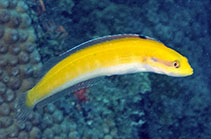
Lives in holes in coral and rock, but leaves burrow to swim freely in water column. Mimics the bluehead, Thalassoma bifasciatum, in order to get close to small fish and shrimps on which it preys. Also feeds on copepods (Ref. 5521).
Life cycle and mating behavior
Maturity | Reproduction | Spawning | Eggs | Fecundity | Larvae
Robins, C.R. and G.C. Ray, 1986. A field guide to Atlantic coast fishes of North America. Houghton Mifflin Company, Boston, U.S.A. 354 p. (Ref. 7251)
IUCN Red List Status (Ref. 130435)
Threat to humans
Harmless
Human uses
Aquarium: commercial
More information
Common namesSynonymsMetabolismPredatorsEcotoxicologyReproductionMaturitySpawningSpawning aggregationFecundityEggsEgg development
Age/SizeGrowthLength-weightLength-lengthLength-frequenciesMorphometricsMorphologyLarvaeLarval dynamicsRecruitmentAbundanceBRUVS
ReferencesAquacultureAquaculture profileStrainsGeneticsElectrophoresesHeritabilityDiseasesProcessingNutrientsMass conversion
Tools
Special reports
Download XML
Internet sources
Estimates based on models
Phylogenetic diversity index (Ref.
82804): PD
50 = 1.0000 [Uniqueness, from 0.5 = low to 2.0 = high].
Bayesian length-weight: a=0.00457 (0.00183 - 0.01143), b=3.08 (2.86 - 3.30), in cm total length, based on LWR estimates for this (Sub)family-body shape (Ref.
93245).
Trophic level (Ref.
69278): 3.7 ±0.55 se; based on food items.
Fishing Vulnerability (Ref.
59153): Low vulnerability (10 of 100).