Teleostei (teleosts) >
Ophidiiformes (Cusk eels) >
Bythitidae (Livebearing brotulas)
Etymology: Hastatobythites: Latin, hastatus = formed like a spear-head, 1854 + Greek, bythites, -idos = the bottom of the sea (Ref. 45335).
Environment: milieu / climate zone / depth range / distribution range
Ecology
Marine; benthopelagic; depth range 146 - 850 m (Ref. 34024). Deep-water
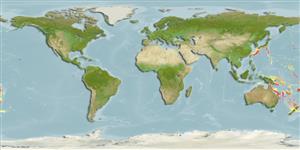
Western Pacific: Arafura Sea to off New South Wales, Australia.
Size / Weight / Age
Maturity: Lm ? range ? - ? cm
Max length : 9.0 cm SL male/unsexed; (Ref. 34024)
Dorsal
soft rays
(total): 99-100;
Anal
soft rays: 64 - 65;
Vertebrae: 57 - 58. This species is distinguished by the following characters: 2 spines on midline of head, one anteriorly directed on frontal above eye and another upward directed, weak and thin on ethmoid, 3 bony ridges on dorsum behind frontal spine; maximum width of head 5.6-6.0% SL, of body 3.5-3.9 % SL; elongated body with joined vertical fins; head naked, with anterior part of body having scattered scales in midline and posterior half almost fully scaled; skin thin and translucent; eye diameter less than snout-length; opercular spine covered by skin; posterior part of maxilla greatly expanded vertically; dentigerous bones with granular teeth; palatines in 2-3 rows; pectoral peduncle slightly longer than broad, not adnate; gill opening extending well above opercular spine; anterior gill arch with 3 long rakers; vertebrae, precaudal 15, total 57-58; D 99-100, A 64-65, pectoral 16-17, caudal 12; otolith length to height = 2.5, with sulcus undivided, placed in central part of inner face, and otolith length to sulcus length = 2.7 (Ref. 93007).
A viviparous, benthic species found on the lower continental shelf and slope (Ref. 75154, 93007). Rare species (Ref. 34024). A 5.7 cm SL female with full developed embryos (Ref. 34024).
Life cycle and mating behavior
Maturity | Reproduction | Spawning | Eggs | Fecundity | Larvae
Nielsen, J.G., W. Schwarzhans and D.M. Cohen, 2012. Revisions of Hastatobythites and Saccogaster (Teleostei, Bythitidae) with three new species and a new genus. Zootaxa 3579:1-36. (Ref. 93007)
IUCN Red List Status (Ref. 130435)
Threat to humans
Harmless
Human uses
Fisheries: of no interest
More information
Common namesSynonymsMetabolismPredatorsEcotoxicologyReproductionMaturitySpawningSpawning aggregationFecundityEggsEgg development
ReferencesAquacultureAquaculture profileStrainsGeneticsElectrophoresesHeritabilityDiseasesProcessingNutrientsMass conversion
Tools
Special reports
Download XML
Internet sources
Estimates based on models
Preferred temperature (Ref.
123201): 9.2 - 18.7, mean 13.8 °C (based on 95 cells).
Phylogenetic diversity index (Ref.
82804): PD
50 = 1.0000 [Uniqueness, from 0.5 = low to 2.0 = high].
Bayesian length-weight: a=0.00457 (0.00179 - 0.01169), b=3.10 (2.87 - 3.33), in cm total length, based on LWR estimates for this (Sub)family-body shape (Ref.
93245).
Trophic level (Ref.
69278): 3.3 ±0.5 se; based on size and trophs of closest relatives
Resilience (Ref.
120179): Low, minimum population doubling time 4.5 - 14 years (Assuming Fec < 100).
Fishing Vulnerability (Ref.
59153): Low vulnerability (10 of 100).