Teleostei (teleosts) >
Anguilliformes (Eels and morays) >
Muraenidae (Moray eels) > Muraeninae
Etymology: Gymnothorax: Greek, gymnos = naked + Greek, thorax, -akos = breast (Ref. 45335).
More on author: Castelnau.
Environment: milieu / climate zone / depth range / distribution range
Ecology
Marine; reef-associated; depth range ? - 145 m (Ref. 5288). Subtropical
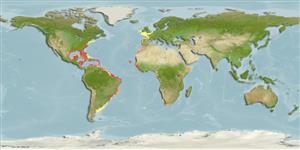
Western Atlantic: Bermuda, southern Florida (USA), and the Bahamas to Brazil. Eastern Atlantic: Azores, Madeira, the Canary Islands, Cape Verde, and islands of Bay of Biafra (Ref. 4450); Ascension I. (Ref. 98447).
Size / Weight / Age
Maturity: Lm ? range ? - ? cm
Max length : 132 cm TL male/unsexed; (Ref. 104752); common length : 70.0 cm TL male/unsexed; (Ref. 5217); max. published weight: 750.00 g (Ref. 40637)
Short description
Morphology | Morphometrics
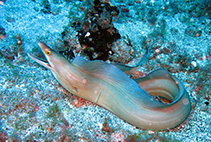
Mottled greenish or brown overall, often with darker flecks. Anal and caudal fins have white margins that continue onto rear third and sometimes entire length of dorsal fin (Ref. 26938).
A benthic and solitary species (Ref. 26340) inhabiting rocky shores and reefs where water is clear. Most active at night (Ref. 9710). Marketed fresh (Ref. 5217). May cause serious wounds (Ref. 5217). Traded as an aquarium fish at Ceará, Brazil (Ref. 49392).
Life cycle and mating behavior
Maturity | Reproduction | Spawning | Eggs | Fecundity | Larvae
Robins, C.R. and G.C. Ray, 1986. A field guide to Atlantic coast fishes of North America. Houghton Mifflin Company, Boston, U.S.A. 354 p. (Ref. 7251)
IUCN Red List Status (Ref. 130435)
Threat to humans
Traumatogenic (Ref. 5217)
Human uses
Fisheries: minor commercial; aquarium: commercial
More information
Common namesSynonymsMetabolismPredatorsEcotoxicologyReproductionMaturitySpawningSpawning aggregationFecundityEggsEgg development
ReferencesAquacultureAquaculture profileStrainsGeneticsElectrophoresesHeritabilityDiseasesProcessingNutrientsMass conversion
Tools
Special reports
Download XML
Internet sources
Estimates based on models
Preferred temperature (Ref.
123201): 19.5 - 27.9, mean 25.4 °C (based on 660 cells).
Phylogenetic diversity index (Ref.
82804): PD
50 = 0.5000 [Uniqueness, from 0.5 = low to 2.0 = high].
Bayesian length-weight: a=0.00058 (0.00037 - 0.00089), b=3.26 (3.14 - 3.38), in cm total length, based on LWR estimates for this species & Genus-body shape (Ref.
93245).
Trophic level (Ref.
69278): 4.3 ±0.6 se; based on diet studies.
Resilience (Ref.
120179): Very Low, minimum population doubling time more than 14 years (Preliminary K or Fecundity.).
Fishing Vulnerability (Ref.
59153): Very high vulnerability (79 of 100).
Nutrients (Ref.
124155): Calcium = 13.6 [6.8, 27.0] mg/100g; Iron = 0.444 [0.240, 0.866] mg/100g; Protein = 19.4 [17.2, 21.9] %; Omega3 = 0.167 [0.069, 0.494] g/100g; Selenium = 27.6 [13.1, 57.0] μg/100g; VitaminA = 49.7 [14.0, 179.5] μg/100g; Zinc = 0.486 [0.319, 0.734] mg/100g (wet weight);