Teleostei (teleosts) >
Anguilliformes (Eels and morays) >
Congridae (Conger and garden eels) > Heterocongrinae
Etymology: Gorgasia: From Greek mithology, Gorgas, -ados = the Gorgone´s head (Ref. 45335); galzini: Named for René Galzin..
More on authors: Castle & Randall.
Environment: milieu / climate zone / depth range / distribution range
Ecology
Marine; demersal; non-migratory; depth range 35 - 53 m (Ref. 33408). Tropical
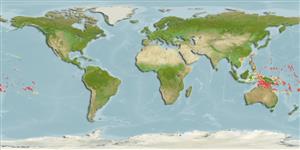
Pacific Ocean: Guam and Australia to the Society Islands (French Polynesia).
Length at first maturity / Size / Weight / Age
Maturity: Lm ?, range 37 - ? cm
Max length : 53.0 cm TL male/unsexed; (Ref. 33408); common length : 33.0 cm TL male/unsexed; (Ref. 33408)
Short description
Morphology | Morphometrics
Dorsal
spines
(total): 0;
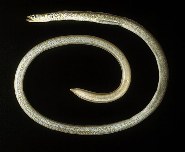
Vertebrae: 178 - 188. Slender species with 38-44 preanal pores, dorsal fin origin over middle of pectoral fin, and body color of minute, closely packed, dark spots that are more prominent above lateral line, widely spaced dark spots along edge of dorsal fin, white postorbital patches, a silver iris prominently edged with black, and dark peritoneal pigment ventrally on abdomen.
In dense colonies of about 6 individuals per square meter. Feeds on zooplankton (Ref. 33408, 89972). Diet mainly composed of calanoid copepods, gelatinous plankton, invertebrate pelagic eggs, siphonophores, decapod larvae, fish eggs, particles of organic matter and larvaceans. (Ref. 33447).
Life cycle and mating behavior
Maturity | Reproduction | Spawning | Eggs | Fecundity | Larvae
Castle, P.H.J. and J.E. Randall, 1999. Revision of Indo-Pacific garden eels (Congridae: Heterocongrinae), with descriptions of five new species. Indo-Pac. Fish. (30):52 p. (Ref. 33408)
IUCN Red List Status (Ref. 130435)
Threat to humans
Harmless
Human uses
Fisheries: of no interest
More information
Age/SizeGrowthLength-weightLength-lengthLength-frequenciesMorphometricsMorphologyLarvaeLarval dynamicsRecruitmentAbundanceBRUVS
ReferencesAquacultureAquaculture profileStrainsGeneticsElectrophoresesHeritabilityDiseasesProcessingNutrientsMass conversion
Tools
Special reports
Download XML
Internet sources
Estimates based on models
Preferred temperature (Ref.
123201): 26.4 - 28.5, mean 27.6 °C (based on 12 cells).
Phylogenetic diversity index (Ref.
82804): PD
50 = 0.5001 [Uniqueness, from 0.5 = low to 2.0 = high].
Bayesian length-weight: a=0.00102 (0.00046 - 0.00225), b=3.06 (2.88 - 3.24), in cm total length, based on all LWR estimates for this body shape (Ref.
93245).
Trophic level (Ref.
69278): 3.4 ±0.4 se; based on size and trophs of closest relatives
Resilience (Ref.
120179): Medium, minimum population doubling time 1.4 - 4.4 years (Preliminary K or Fecundity.).
Fishing Vulnerability (Ref.
59153): Moderate vulnerability (41 of 100).
Nutrients (Ref.
124155): Calcium = 132 [75, 243] mg/100g; Iron = 1.17 [0.70, 1.92] mg/100g; Protein = 17.8 [14.9, 20.7] %; Omega3 = 0.188 [0.085, 0.504] g/100g; Selenium = 61.6 [31.3, 131.3] μg/100g; VitaminA = 27.6 [8.3, 90.0] μg/100g; Zinc = 0.945 [0.679, 1.323] mg/100g (wet weight);