Teleostei (teleosts) >
Acanthuriformes (Surgeonfishes) >
Pomacanthidae (Angelfishes)
Etymology: Genicanthus: Greek, geny, -yos = face, jaw + Greek, akantha = thorn (Ref. 45335).
More on author: Randall.
Environment: milieu / climate zone / depth range / distribution range
Ecology
Marine; reef-associated; non-migratory; depth range 40 - 100 m (Ref. 89972). Subtropical
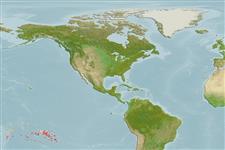
Eastern Pacific: Cook Islands to Ducie Atoll (Pitcairn).
Size / Weight / Age
Maturity: Lm ? range ? - ? cm
Max length : 35.0 cm TL male/unsexed; (Ref. 4858)
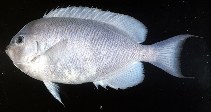
Inhabits rock and coral reef at depths of 30 to at least 60 m. Occurs in aggregations that swim high above the bottom; harems of 2-5 individuals. Feeds mainly on zooplankton, although some benthic material is probably consumed (Ref. 4858). Almost never exported through the aquarium trade (Ref. 48391).
Life cycle and mating behavior
Maturity | Reproduction | Spawning | Eggs | Fecundity | Larvae
Allen, G.R., 1985. Butterfly and angelfishes of the world. Vol. 2. 3rd edit. in English. Mergus Publishers, Melle, Germany. (Ref. 4858)
IUCN Red List Status (Ref. 130435)
Threat to humans
Harmless
Human uses
More information
Common namesSynonymsMetabolismPredatorsEcotoxicologyReproductionMaturitySpawningSpawning aggregationFecundityEggsEgg development
ReferencesAquacultureAquaculture profileStrainsGeneticsElectrophoresesHeritabilityDiseasesProcessingNutrientsMass conversion
Tools
Special reports
Download XML
Internet sources
Estimates based on models
Preferred temperature (Ref.
123201): 25.1 - 28.4, mean 27.4 °C (based on 133 cells).
Phylogenetic diversity index (Ref.
82804): PD
50 = 0.5010 [Uniqueness, from 0.5 = low to 2.0 = high].
Bayesian length-weight: a=0.03090 (0.01359 - 0.07026), b=2.89 (2.70 - 3.08), in cm total length, based on LWR estimates for this (Sub)family-body shape (Ref.
93245).
Trophic level (Ref.
69278): 3.4 ±0.45 se; based on food items.
Resilience (Ref.
120179): Low, minimum population doubling time 4.5 - 14 years (Preliminary K or Fecundity.).
Fishing Vulnerability (Ref.
59153): Low vulnerability (25 of 100).