Environment: milieu / climate zone / depth range / distribution range
Ecology
Marine; brackish; reef-associated; depth range 10 - 200 m (Ref. 9563), usually 18 - 57 m (Ref. 47377). Tropical; 44°N - 39°S
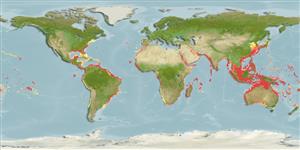
Western Atlantic: southeastern Florida, USA to Central America according to Ref. 7251, Massachusetts to southern Brazil (Ref. 47377). Also found in Argentina (Ref. 86323). Eastern Atlantic: Galicia, Spain (Ref. 74931), Cape Blanc and Cape Verde to Angola (Ref. 6557). Reported from Walvis Bay, Namibia (Ref. 4272). Indo-Pacific: Red Sea and East Africa to the Hawaiian and Tuamoto islands, north to southern Japan and the Ogasawara Islands, south to Victoria, Australia (Ref. 33390). This name has often wrongly been used for the more common Fistularia commersonii (Ref. 2334). Mediterranean: Cadiz, Spain (southern Iberian Peninsula) (Ref. 34227).
Size / Weight / Age
Maturity: Lm ? range ? - ? cm
Max length : 200 cm TL male/unsexed; (Ref. 26999); common length : 180 cm TL male/unsexed; (Ref. 47377); max. published weight: 4.7 kg (Ref. 4883)
Short description
Morphology | Morphometrics
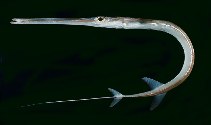
Found in the sublittoral zone (Ref. 11230); inhabits coastal areas over soft bottoms, usually at depths greater than 10 m (Ref. 30573). Benthopelagic (Ref. 58302). Feeds on small fishes and shrimps (Ref. 3401). Maximum length reported is 200 cm TL (Ref. 26999), however, no specimen over 100 cm is known to J.E. Randall (Ref. 11441).
Life cycle and mating behavior
Maturity | Reproduction | Spawning | Eggs | Fecundity | Larvae
Fritzsche, R.A., 1990. Fistulariidae. p. 654-655. In J.C. Quero, J.C. Hureau, C. Karrer, A. Post and L. Saldanha (eds.) Check-list of the fishes of the eastern tropical Atlantic (CLOFETA). JNICT, Lisbon; SEI, Paris; and UNESCO, Paris. Vol. 2. (Ref. 6557)
IUCN Red List Status (Ref. 130435)
Threat to humans
Harmless
Human uses
Fisheries: subsistence fisheries
More information
ReferencesAquacultureAquaculture profileStrainsGeneticsElectrophoresesHeritabilityDiseasesProcessingNutrientsMass conversion
Tools
Special reports
Download XML
Internet sources
Estimates based on models
Preferred temperature (Ref.
123201): 21.3 - 29, mean 27.5 °C (based on 2574 cells).
Phylogenetic diversity index (Ref.
82804): PD
50 = 0.6250 [Uniqueness, from 0.5 = low to 2.0 = high].
Bayesian length-weight: a=0.00046 (0.00027 - 0.00077), b=3.05 (2.90 - 3.20), in cm total length, based on LWR estimates for this species & (Sub)family-body (Ref.
93245).
Trophic level (Ref.
69278): 4.4 ±0.5 se; based on diet studies.
Resilience (Ref.
120179): Medium, minimum population doubling time 1.4 - 4.4 years (Preliminary K or Fecundity.).
Fishing Vulnerability (Ref.
59153): Very high vulnerability (90 of 100).
Nutrients (Ref.
124155): Calcium = 27.8 [13.8, 54.0] mg/100g; Iron = 0.659 [0.360, 1.241] mg/100g; Protein = 19 [18, 20] %; Omega3 = 0.112 [0.055, 0.241] g/100g; Selenium = 103 [49, 218] μg/100g; VitaminA = 19.3 [5.8, 63.6] μg/100g; Zinc = 0.747 [0.487, 1.175] mg/100g (wet weight);