Actinopterygii (ray-finned fishes) >
Clupeiformes (Herrings) >
Engraulidae (Anchovies)
Etymology: Engraulis: Greek, eggraulis, -eos = anchovy (Ref. 45335).
Environment / Climate / Range
Ecology
Marine; brackish; pelagic-neritic; oceanodromous (Ref. 51243); depth range 0 - 400 m (Ref. 2683). Subtropical; 62°N - 37°S, 18°W - 42°E (Ref. 54230)
Length at first maturity / Size / Weight / Age
Maturity: Lm 9.7, range 9 - 14 cm
Max length : 20.0 cm SL male/unsexed; (Ref. 189); common length : 13.5 cm SL male/unsexed; (Ref. 189); max. reported age: 4 years (Ref. 92138)
Dorsal
spines
(total): 0;
Dorsal
soft rays
(total): 16-18;
Anal
spines: 0;
Anal
soft rays: 13 - 15;
Vertebrae: 46 - 47. Snout pointed; maxilla short, tip blunt, reaching almost to front border of pre-operculum, not projecting beyond tip of second supra-maxilla; tip of lower jaw reaching almost to below nostril. Gill rakers present on hind face of third epibranchial. Pseudobranch longer than eye, reaching onto inner face of operculum. A silver stripe along flank, disappearing with age.
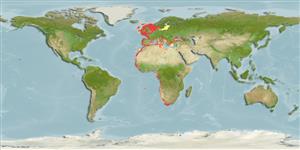
Eastern Atlantic: Bergen, Norway to East London, South Africa (perhaps reaching Durban) (Ref. 10000). Also all of Mediterranean, Black and Azov seas, with stray individuals in Suez Canal and Gulf of Suez; also recorded from St. Helena (Ref. 189). Reported from Estonia (Ref. 33247).
Mainly a coastal marine species, forming large schools. Tolerates salinities of 5-41 ppt and in some areas, enters lagoons, estuaries and lakes, especially during spawning. Tends to move further north and into surface waters in summer, retreating and descending in winter. Feeds on planktonic organisms. Spawns from April to November with peaks usually in the warmest months. Eggs are ellipsoidal to oval, floating in the upper 50 m and hatching in 24-65 hours. Marketed fresh, dried, smoked, canned and frozen; made into fish meal (Ref. 9987).
Whitehead, P.J.P., G.J. Nelson and T. Wongratana, 1988. FAO Species Catalogue. Vol. 7. Clupeoid fishes of the world (Suborder Clupeoidei). An annotated and illustrated catalogue of the herrings, sardines, pilchards, sprats, shads, anchovies and wolf-herrings. FAO Fish. Synop. 125(7/2):305-579. Rome: FAO.
IUCN Red List Status (Ref. 90363)
Threat to humans
Harmless
Human uses
Fisheries: highly commercial; bait: usually
Tools
Special reports
Download XML
Internet sources
Estimates of some properties based on empirical models
Phylogenetic diversity index (Ref.
82805): PD
50 = 0.5020 [Uniqueness, from 0.5 = low to 2.0 = high].
Bayesian length-weight: a=0.00521 (-0.02268 - 0.03309), b=3.05 (3.03 - 3.07), based on LWR estimates for this species (Ref.
93245).
Trophic Level (Ref.
69278): 3.1 ±0.45 se; Based on food items.
Resilience (Ref.
69278): Medium, minimum population doubling time 1.4 - 4.4 years (K=0.21-1.2; tm=1; tmax=4; Fec = 13,000).
Vulnerability (Ref.
59153): Low vulnerability (14 of 100) .