Teleostei (teleosts) >
Clupeiformes (Herrings) >
Dussumieriidae (Round herrings)
Etymology: Dussumieria: In honor of Dussumier, a collaborator of Cuvier, who sent him collections of fishes from the Indian Ocean (Ref. 45335).
More on author: Valenciennes.
Environment: milieu / climate zone / depth range / distribution range
Ecology
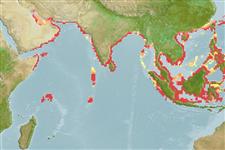
Marine; freshwater; brackish; pelagic-neritic; depth range 10 - 20 m (Ref. 12260). Subtropical; 31°N - 7°S, 49°E - 126°E (Ref. 54426)
Indo-West Pacific; Persian Gulf, north to Taiwan up to Singapore.
Size / Weight / Age
Maturity: Lm ? range ? - ? cm
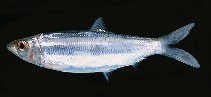
Max length : 20.0 cm SL male/unsexed; (Ref. 188)
Mainly a pelagic inshore species (Ref. 68964). Earlier studies on the habitat and biology may have equally referred to D. elopsoides which this species closely resembles. Can also be caught with ringnets and dipnets. Occurrence reportedly reaches inland (Ref. 94476).
Life cycle and mating behavior
Maturity | Reproduction | Spawning | Eggs | Fecundity | Larvae
Hata, H., S. Lavoué and H. Motomura, 2020. Redescriptions of Dussumieria acuta Valenciennes 1847 and Dussumieria albulina (Fowler 1934), two valid species of rainbow sardines (Clupeiformes: Dussumieriidae). Ichthyological Research 68(1):126-138.
[First published online, pp. 1-13, 22 Sept. 2020; volume, issue and pages added 16 Jan. 2021.] (Ref. 127773)
IUCN Red List Status (Ref. 130435)
Threat to humans
Harmless
Human uses
Fisheries: highly commercial
More information
Common namesSynonymsMetabolismPredatorsEcotoxicologyReproductionMaturitySpawningSpawning aggregationFecundityEggsEgg development
Tools
Special reports
Download XML
Internet sources
Estimates based on models
Preferred temperature (Ref.
123201): 25.9 - 29.3, mean 28.8 °C (based on 1387 cells).
Phylogenetic diversity index (Ref.
82804): PD
50 = 0.7520 [Uniqueness, from 0.5 = low to 2.0 = high].
Bayesian length-weight: a=0.00832 (0.00629 - 0.01100), b=2.99 (2.91 - 3.07), in cm total length, based on LWR estimates for this species (Ref.
93245).
Trophic level (Ref.
69278): 3.4 ±0.45 se; based on food items.
Generation time: 1.5 ( na - na) years. Estimated as median ln(3)/K based on 1
growth studies.
Resilience (Ref.
120179): High, minimum population doubling time less than 15 months (K=0.8-1.2; tmax=1).
Prior r = 1.19, 95% CL = 0.79 - 1.79, Based on 3 stock assessments.
Fishing Vulnerability (Ref.
59153): Low vulnerability (20 of 100).
Climate Vulnerability (Ref.
125649): High to very high vulnerability (66 of 100).
Nutrients (Ref.
124155): Calcium = 231 [130, 523] mg/100g; Iron = 1.41 [0.74, 2.77] mg/100g; Protein = 21.3 [19.7, 22.6] %; Omega3 = 0.319 [0.155, 0.647] g/100g; Selenium = 77.1 [29.6, 207.7] μg/100g; VitaminA = 5.97 [1.78, 20.81] μg/100g; Zinc = 1.93 [1.27, 2.87] mg/100g (wet weight); based on
nutrient studies.