Teleostei (teleosts) >
Beloniformes (Needle fishes) >
Exocoetidae (Flyingfishes)
Etymology: Cypselurus: Greek, kypselos, ou = swift + Greek,oura = tail (Ref. 45335).
More on author: Mitchill.
Environment: milieu / climate zone / depth range / distribution range
Ecology
Marine; pelagic-neritic; oceanodromous (Ref. 51243); depth range 0 - ? m. Subtropical
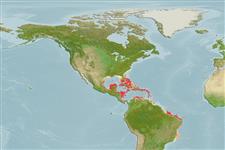
Western Atlantic: Florida, USA and northern Gulf of Mexico to Brazil.
Size / Weight / Age
Maturity: Lm ? range ? - ? cm
Max length : 30.0 cm TL male/unsexed; (Ref. 7251); common length : 15.0 cm TL male/unsexed; (Ref. 5217)
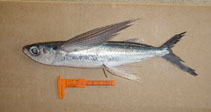
Inhabits near shore surface waters. Capable of leaping out of the water and gliding for long distances above the surface.
Life cycle and mating behavior
Maturity | Reproduction | Spawning | Eggs | Fecundity | Larvae
Robins, C.R. and G.C. Ray, 1986. A field guide to Atlantic coast fishes of North America. Houghton Mifflin Company, Boston, U.S.A. 354 p. (Ref. 7251)
IUCN Red List Status (Ref. 130435)
Threat to humans
Harmless
Human uses
Fisheries: subsistence fisheries
More information
Common namesSynonymsMetabolismPredatorsEcotoxicologyReproductionMaturitySpawningSpawning aggregationFecundityEggsEgg development
ReferencesAquacultureAquaculture profileStrainsGeneticsElectrophoresesHeritabilityDiseasesProcessingNutrientsMass conversion
Tools
Special reports
Download XML
Internet sources
Estimates based on models
Preferred temperature (Ref.
123201): 24.9 - 28, mean 27.2 °C (based on 242 cells).
Phylogenetic diversity index (Ref.
82804): PD
50 = 0.5002 [Uniqueness, from 0.5 = low to 2.0 = high].
Bayesian length-weight: a=0.00646 (0.00292 - 0.01429), b=3.04 (2.84 - 3.24), in cm total length, based on LWR estimates for this (Sub)family-body shape (Ref.
93245).
Trophic level (Ref.
69278): 4.0 ±0.6 se; based on size and trophs of closest relatives
Resilience (Ref.
120179): High, minimum population doubling time less than 15 months (Preliminary K or Fecundity.).
Fishing Vulnerability (Ref.
59153): Low vulnerability (20 of 100).