Elasmobranchii (sharks and rays) >
Orectolobiformes (Carpet sharks) >
Hemiscylliidae (Bamboo sharks)
Etymology: Chiloscyllium: cheilos (Gr.), lip, referring to membranous and broad lower lip, presumably of C. plagiosum (proposed without a species); skylion, Greek for dogfish or small shark. (See ETYFish); plagiosum: -osus, Latin suffix denoting fullness or abundance: plagis (L.), stripes, referring to dark transverse bands on body. (See ETYFish).
Environment: milieu / climate zone / depth range / distribution range
Ecology
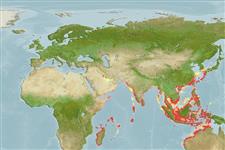
Marine; reef-associated; depth range 0 - 50 m (Ref. 106604). Tropical; 35°N - 10°S, 42°E - 135°E
Indo-West Pacific: India and Maldives east to Papua New Guinea north to Japan, south to Indonesia. Reported from Korea (Ref. 45255).
Length at first maturity / Size / Weight / Age
Maturity: Lm 56.5, range 50 - 63 cm
Max length : 83.0 cm TL male/unsexed; (Ref. 43278); 95.0 cm TL (female); max. reported age: 25 years (Ref. 72467)
Dorsal
spines
(total): 0;
Dorsal
soft rays
(total): 0;
Anal
spines: 0;
Anal
soft rays: 0. Genus: Nostrils subterminal on snout; pre-oral snout long, mouth closer to eyes than snout tip; eyes and supraorbital ridges hardly elevated; no black hood on head or large spot or spots on sides of body above pectoral fins (Ref. 43278). Caudal fin with a pronounced subterminal notch but without a ventral lobe (Ref. 13575). Genus: Nostrils subterminal on snout; pre-oral snout long, mouth closer to eyes than snout tip; eyes and supraorbital ridges hardly elevated; no black hood on head or large spot or spots on sides of body above pectoral fins (Ref. 43278). Caudal fin with a pronounced subterminal notch but without a ventral lobe (Ref. 13575).
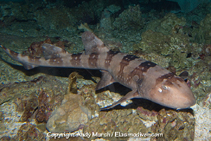
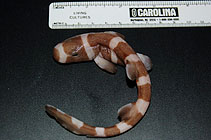
Species: Young and adults with transverse dark bands and numerous white or bluish spots (Ref. 13575, 43278). Body with lateral dermal ridges (Ref. 43278, 13575).
A common but little-known inshore bottom shark (Ref. 247); found on rocks and coral reefs (Ref. 90102). Feeds on bony fishes and crustaceans (Ref. 43278). Oviparous (Ref. 43278, 50449). Utilized for human consumption (Ref. 247) and used in Chinese medicine (Ref. 12166). Caught by multiple hook and line and trawl (Ref. 47736). Caught rarely by demersal gillnet fisheries operating inshore (Ref.58048).
Life cycle and mating behavior
Maturity | Reproduction | Spawning | Eggs | Fecundity | Larvae
Oviparous, paired eggs are laid. Embryos feed solely on yolk (Ref. 50449). Hatches at 10-13 cm TL. In Taiwan, hatching occurs in June to August (Ref.58048).
Compagno, L.J.V., 1984. FAO Species Catalogue. Vol. 4. Sharks of the world. An annotated and illustrated catalogue of shark species known to date. Part 1 - Hexanchiformes to Lamniformes. FAO Fish. Synop. 125(4/1):1-249. Rome, FAO. (Ref. 247)
IUCN Red List Status (Ref. 130435)
Threat to humans
Harmless
Human uses
Fisheries: commercial
Tools
Special reports
Download XML
Internet sources
Estimates based on models
Preferred temperature (Ref.
123201): 25.3 - 29.1, mean 28.7 °C (based on 1458 cells).
Phylogenetic diversity index (Ref.
82804): PD
50 = 0.5039 [Uniqueness, from 0.5 = low to 2.0 = high].
Bayesian length-weight: a=0.00407 (0.00181 - 0.00918), b=3.09 (2.89 - 3.29), in cm total length, based on LWR estimates for this (Sub)family-body shape (Ref.
93245).
Trophic level (Ref.
69278): 4.0 ±0.67 se; based on food items.
Generation time: 6.1 ( na - na) years. Estimated as median ln(3)/K based on 2
growth studies.
Resilience (Ref.
120179): Low, minimum population doubling time 4.5 - 14 years (Fec assumed to be <100).
Fishing Vulnerability (Ref.
59153): Moderate vulnerability (36 of 100).
Nutrients (Ref.
124155): Calcium = 18 [4, 70] mg/100g; Iron = 0.44 [0.11, 1.21] mg/100g; Protein = 19.7 [17.4, 21.8] %; Omega3 = 0.0938 [, ] g/100g; Selenium = 29.8 [8.0, 80.9] μg/100g; VitaminA = 43.7 [15.7, 112.0] μg/100g; Zinc = 0.791 [0.379, 1.672] mg/100g (wet weight);