Teleostei (teleosts) >
Eupercaria/misc (Various families in series Eupercaria) >
Scaridae (Parrotfishes) > Scarinae
Etymology: Cetoscarus: Greek, ketos = a marine monster, whale + Greek, skaros = a fish cited by ancient writers; a parrot fish (Ref. 45335).
More on author: Rüppell.
Issue
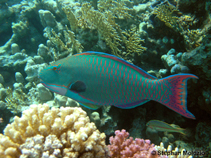
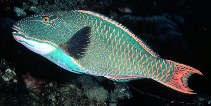
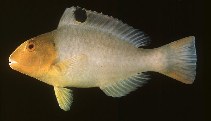
This species is endemic to the Red Sea (Ref. 54980:447, species treatment in prep). Correction of data other than distribution is in progress (information transfer to C. ocellatus of the Indo-Pacific).
Environment: milieu / climate zone / depth range / distribution range
Ecology
Marine; reef-associated; depth range 1 - 30 m (Ref. 27115). Tropical; 24°C - 28°C (Ref. 27115); 33°N - 12°N, 32°E - 44°E
Western Indian Ocean: Red Sea endemic.
Size / Weight / Age
Maturity: Lm ? range ? - ? cm
Max length : 50.0 cm SL male/unsexed; (Ref. 115947); max. published weight: 2.4 kg (Ref. 125599)
Benthic grazer of algae (Ref. 3488). Caught with nets and other types of artisanal gear.
Life cycle and mating behavior
Maturity | Reproduction | Spawning | Eggs | Fecundity | Larvae
Oviparous, distinct pairing during breeding (Ref. 205).
Choat, J.H., B. Russell, K.D. Clements, L.A. Rocha, R. Myers, M.E. Lazuardi, A. Muljadi, S. Pardede and P. Rahardjo, 2012. Cetoscarus bicolor. The IUCN Red List of Threatened Species 2012:e.T190690A17793737. Downloaded on 03 August 2017. (Ref. 115947)
IUCN Red List Status (Ref. 130435)
Threat to humans
Harmless
Human uses
Fisheries: commercial; aquarium: commercial
More information
ReferencesAquacultureAquaculture profileStrainsGeneticsElectrophoresesHeritabilityDiseasesProcessingNutrientsMass conversion
Tools
Special reports
Download XML
Internet sources
Estimates based on models
Preferred temperature (Ref.
123201): 24.9 - 29.1, mean 27.9 °C (based on 1232 cells).
Phylogenetic diversity index (Ref.
82804): PD
50 = 0.7500 [Uniqueness, from 0.5 = low to 2.0 = high].
Bayesian length-weight: a=0.01202 (0.00687 - 0.02104), b=3.02 (2.87 - 3.17), in cm total length, based on LWR estimates for this species & (Sub)family-body (Ref.
93245).
Trophic level (Ref.
69278): 2.0 ±0.00 se; based on food items.
Resilience (Ref.
120179): Low, minimum population doubling time 4.5 - 14 years (tm=5; K=0.255; tmax=21).
Fishing Vulnerability (Ref.
59153): Low to moderate vulnerability (34 of 100).
Nutrients (Ref.
124155): Calcium = 46.4 [27.3, 85.4] mg/100g; Iron = 0.707 [0.384, 1.179] mg/100g; Protein = 18.7 [16.6, 20.5] %; Omega3 = 0.0992 [, ] g/100g; Selenium = 36.4 [21.1, 68.4] μg/100g; VitaminA = 37.9 [11.8, 127.8] μg/100g; Zinc = 1.55 [1.07, 2.42] mg/100g (wet weight);